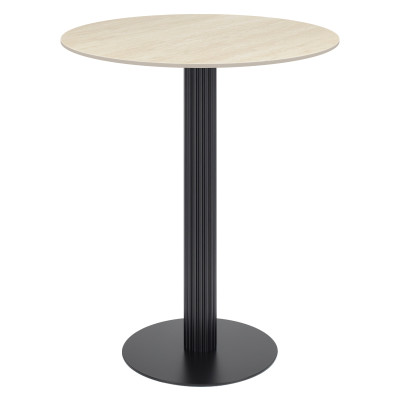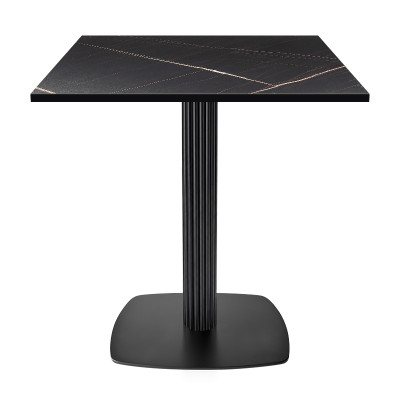
Sintered Stone vs Melamine vs HPL vs MDF — A Wholesale Buyer's Guide to Commercial Table Tops
If you sell commercial tables to restaurants, cafes, or hotels, the tabletop you choose will be the single biggest factor in how the table looks, how it performs, and how your customer perceives your brand.
But here's the catch: most "wood-look" tabletops sold in the commercial furniture market are not solid wood. They're engineered substrates — and the substrate you choose determines whether your table survives five years or fifteen.
This guide compares the four most common tabletop materials you'll encounter when sourcing from a Chinese commercial furniture manufacturer: sintered stone, melamine-faced board, high-pressure laminate (HPL), and MDF-based panels. We use each of these at AEONTI, and we'll be direct about the trade-offs.
A Quick Note on "Wood Tops"
If your customer expects a "solid wood" table top, the unit price will be 3–5x an engineered alternative, and the table will be vulnerable to warping in humid commercial environments (poolside, outdoor patio, coastal restaurants). For most B2B commercial applications, an engineered wood-look top will outperform solid wood on every metric that matters: dimensional stability, scratch resistance, moisture resistance, and cost.
That said, the right engineered choice depends on the application. Here's how to think through it.
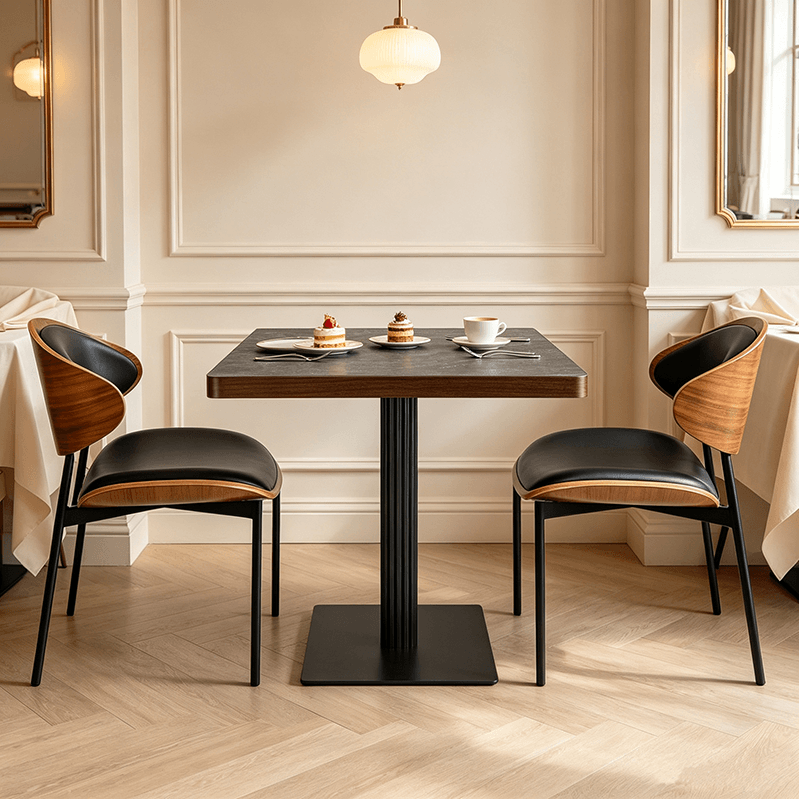
The Four Tabletop Substrates Compared
| Substrate | Construction | Best Application | Avoid In |
| Sintered Stone | Natural minerals sintered at 1200°C | Fine dining, hotel F&B, premium cafes | High-impact fast-casual (cost overkill) |
| Melamine-Faced Board (MFC) | Particleboard/MDF core + melamine paper | Cafes, casual dining, co-working spaces | Outdoor, high-moisture, heavy commercial use |
| High-Pressure Laminate (HPL) | Kraft paper layers + phenolic resin, bonded to substrate | Restaurants, fast-casual, indoor commercial | Direct water exposure unless edge-sealed |
MDF Core with HPL Face | MDF core + HPL surface layer | Mid-to-high traffic indoor dining | Outdoor or high-moisture areas |
1. Sintered Stone Tabletops
What it is: A man-made slab produced by sintering natural minerals (clay, feldspar, silica) at temperatures above 1200°C. The result is a dense, non-porous surface that mimics natural stone without the weight or maintenance.
Strengths:
• Scratch, stain, heat, and UV resistant
• Non-porous — no sealing required
• Available in marble, concrete, and wood-look finishes
• 10–15 year commercial lifespan
Trade-offs:
• Heavier than engineered wood — adds shipping cost
• Higher unit price (typically 2–3x melamine)
• Edge finishing requires specialized equipment
Best for: Fine dining, hotel restaurants, premium cafes, and any application where the visual is part of the brand experience.
2. Melamine-Faced Board (MFC)
What it is: A particleboard or MDF core bonded with a printed melamine paper surface. This is the workhorse of the commercial furniture industry — it covers the majority of mid-market restaurant tables globally.
Strengths:
• Most cost-effective tabletop option
• Wide range of wood-grain, stone, and solid-color finishes
• Lightweight and easy to fabricate
• Consistent batch-to-batch appearance
Trade-offs:
• Edge sealing is critical — exposed particleboard will absorb moisture
• Not suitable for outdoor use unless specifically rated
• Lower impact resistance than stone or HPL
• Shorter commercial lifespan (5–8 years in heavy use)
Best for: Cafes, casual dining, co-working spaces, fast-casual chains with multi-location rollouts.
3. High-Pressure Laminate (HPL)
What it is: Multiple layers of kraft paper saturated with phenolic resin, compressed under high pressure and heat, then bonded to a substrate (usually MDF or plywood). HPL is significantly more durable than standard melamine.
Strengths:
• Excellent wear, scratch, and impact resistance
• Available in a huge range of commercial-grade finishes
• Better moisture resistance than melamine (when edge-sealed)
• 8–12 year commercial lifespan
Trade-offs:
• Higher cost than melamine
• Still requires edge sealing for wet environments
• Some finishes show wear in extreme high-traffic applications
Best for: Full-service restaurants, hotel F&B, and any indoor application where the table will see 5+ years of daily use.
4. MDF Core with HPL Face
What it is: A composite panel where the core is medium-density fiberboard and the surface is a separately applied HPL layer. This is the most common construction for mid-to-high-end commercial tabletops in the Chinese OEM market.
Strengths:
• Very smooth, consistent surface for HPL bonding
• Better screw-holding and edge-banding than particleboard
• Wide customization on thickness, edge profile, and finish
• 8–12 year commercial lifespan
Trade-offs:
• Heavier than pure MFC
• Edge sealing is non-negotiable
• Not rated for outdoor or high-moisture use
Best for: Indoor commercial dining at mid-to-high traffic levels, where finish quality and consistency matter.
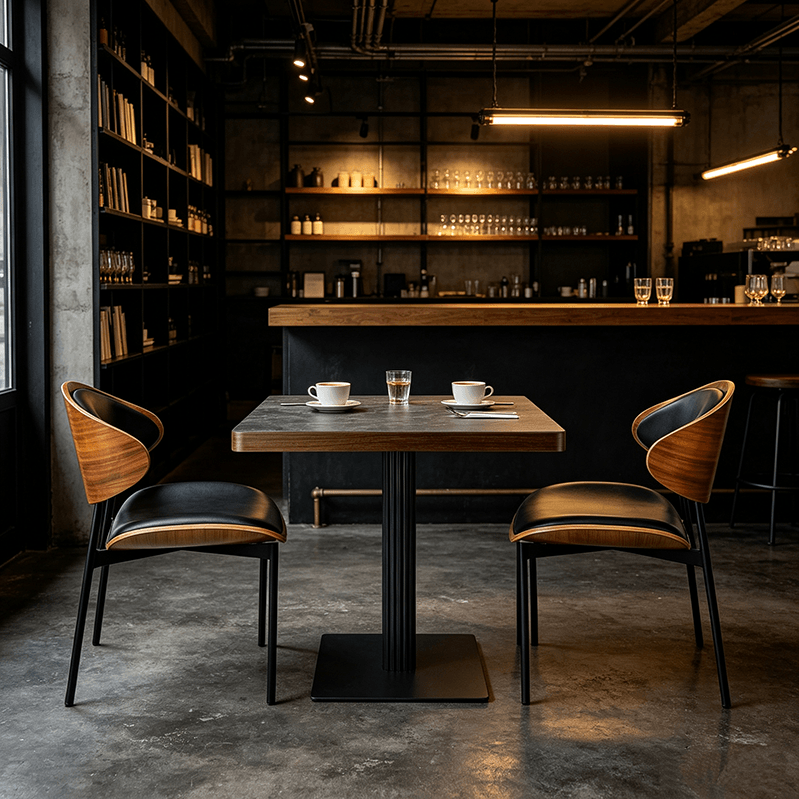
How to Choose: A 5-Question Decision Framework
When you're configuring a tabletop for a commercial project, ask these five questions:
1.What's the environment? Indoor dry, indoor humid (poolside, kitchen-adjacent), or outdoor?
2.What's the expected service life? 5 years, 10 years, or 15+ years?
3.How important is the brand visual? Premium (sintered stone) or functional (MFC)?
4.What's the per-table shipping budget? Heavier tops add 15–30% to FOB cost.
5.Will the top be edge-sealed, and by whom? Unsealed engineered tops fail early regardless of substrate.
If you can't answer these questions with your customer, the safest default for most indoor commercial dining is MDF core with HPL face. It delivers 80% of the performance of sintered stone at roughly 40% of the cost.
How AEONTI Configures Tabletops
At AEONTI, we supply all four substrate options across our table top wholesale line. Our standard configurations are:
• Sintered stone 12 mm with reinforced backing, edge-polished
• MFC 25 mm with PVC edge banding, commercial-grade melamine
• HPL-faced MDF 25 mm with matching PVC or aluminum edge
• Custom substrate + finish combinations for OEM/ODM projects
MOQ starts at 100 sets, with mixed container loading supported across base, top, and chair categories. Standard lead time is 25–30 days for in-stock finishes, longer for custom colors.
Not Sure Which Substrate Fits Your Project?
Send us your application details — environment, traffic level, target unit price, and brand visual goals — and our wholesale team will recommend a substrate configuration with sample options within 248 hours.
📞 WhatsApp: +86 17841353079
📧 Email: aeonti@aeonti.com
🌐 Website: www.aeonti.com