Table Base Manufacturer vs Supplier: What Is the Difference?
When you plan to place bulk orders for metal table bases, you will come across countless “suppliers” online. Their quotations may look attractive and samples can be delivered. Yet once you place formal orders, you may face prolonged lead‑times, excessive dimensional tolerances, or unfulfilled customization requests. Where does the problem lie? Chances are you are working with a trading‑oriented supplier instead of a real manufacturer.
In the global furniture supply chain, the terms “Manufacturer” and “Supplier” are frequently used interchangeably. However, they differ drastically in capabilities, liabilities and pricing structures. Failure to distinguish between them may result in unnecessary extra costs, compromised order quality & lead‑time, and even loss of end‑customers.
Taking metal table bases as an example, this blog breaks down:
‑ The essential differences between manufacturers and suppliers
‑ A comparison table covering key dimensions
‑ 6 quick‑check questions to verify whether you are dealing with a genuine factory
‑ What benefits you can get by sourcing directly from manufacturers
What Is a Table Base Manufacturer?
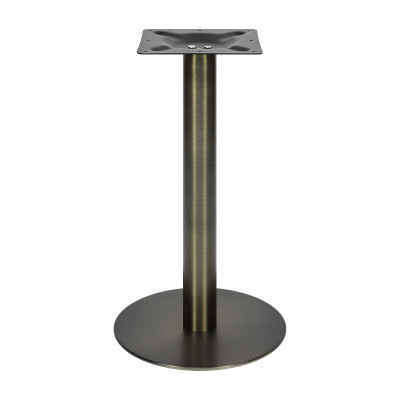
A manufacturer turns raw materials into finished products. For table‑base production, a qualified manufacturer maintains a complete production workflow:
| Process | What the Manufacturer Does |
| Raw Material Sourcing | Direct procurement of stainless‑steel coils, aluminum profiles, cast iron, steel plates and other raw materials |
| Forming & Fabrication | Cutting, stamping, bending, welding, casting (cast iron / cast aluminum) |
| Surface Treatment | In‑house polishing, brushing, spraying, electroplating and painting lines |
Quality Control | In‑house QC team conducting batch‑by‑batch inspections on welding strength, dimensional tolerance, load‑bearing capacity and surface flatness |
R&D Capability | Structural design capacity to support OEM (custom‑made per samples) and ODM (custom‑designed development) |
Key features: Manufacturers own workshops, equipment and production lines. Their quotations contain no middle‑man markup, yet they enforce clear MOQ (Minimum Order Quantity) requirements and strict process stability standards.
What Is a Table Base Supplier?
“Supplier” is a broad term referring to any party that can deliver goods. It may stand for:
‑ Trading / import‑export companies: Resell products sourced from multiple factories for profit margins
‑ Trading‑manufacturing integrated enterprises: Operate their own factory while sourcing goods from third‑party manufacturers (closest to genuine manufacturers)
‑ Platform merchants / distributors: Resell finished goods from factories
Key features: Pure trading‑oriented suppliers do not engage in physical production. They excel in product selection, consolidation, inspection and logistics coordination. Low MOQ is one of their advantages. Their major drawback lies in zero control over manufacturing processes. Customization is limited, quality issues can only be spotted after production, and problem resolution requires multi‑layer communication with upstream factories.
Manufacturer vs Trading‑Oriented Supplier: Core Comparison
Below is a side‑by‑side comparison across 10 dimensions:
| Comparison Item | Manufacturer | Trading‑Oriented Supplier |
| Production Capacity | In‑house workshop, equipment and production lines; full‑cycle production from raw materials | No production facilities; purchases finished goods from factories for resale |
| Customization (OEM/ODM) | Supports custom‑made per drawings / samples; adjustable dimensions, materials and surface finishes | Mainly sells standard items; long lead‑time or unfeasible for custom requests |
| Quality Control | Full‑process production monitoring and batch‑by‑batch pre‑shipment inspection | Reliant on upstream factories; only post‑production random inspection is available |
Pricing Structure | Raw‑material cost + processing cost + management cost; no middle‑man markup | Factory exit price + supplier profit; multi‑layer markup |
Minimum Order Quantity (MOQ) | Relatively high (restricted by cutting and mould costs) | Low; small‑batch orders or even drop‑shipping are acceptable |
Lead Time | Subject to production scheduling; capacity reservation is required in peak seasons | Depends on upstream factory stock; fast for stock items, unstable for custom orders |
Technical Communication | Direct access to engineers and workshop teams for technical discussions | Messages relayed to factories; risk of information distortion |
Intellectual Property | Non‑Disclosure Agreement (NDA) and exclusive terms available for new product development | Hard to enforce confidentiality; designs may be shared with other buyers |
Issue Tracing | Clear accountability; quality issues are addressed directly with production teams | Long liability chain; high risk of disputes over claims |
Long‑term Cooperation Value | Joint product development, continuous cost optimization and priority production scheduling available | Suitable for emergency replenishment and small trial orders |
Summary:
Suppliers solve the question of “whether goods are available”. Manufacturers solve the question of “whether goods can be well‑made”. If your business relies on consistent quality, controlled costs and differentiated competitive products, manufacturers deliver far greater long‑term value than short‑term price gaps.
Why This Distinction Matters for Buyers
Table bases are not standard commodities. They bear the full weight of tabletops. Welding integrity, tube thickness and scratch‑resistant surface treatment directly determine end‑user experience and return rates. Sourcing from the wrong partner may lead to:
1. Poor quality: Inconsistent welding strength across batches, wobbling or fractured installations, resulting in after‑sales costs far exceeding the money saved.
2. Failed customization: Traders may verbally approve custom requests without access to engineering teams, leading to endless drawing revisions with no real progress.
3. Uncontrollable lead‑time: During peak seasons, traders get lower production priority compared with direct factory buyers.
4. Hidden markup: Every purchase includes invisible middle‑man profit.
6 Questions to Identify a Genuine Manufacturer
| Questions to Ask | Signs of a Real Manufacturer | |
1 | Can you provide live or recent workshop photos/videos? | Provides real‑time workshop footage, not only official renderings |
2 | What materials and processes do you specialize in? | Clearly explains process routes for stainless steel, aluminum alloy, cast iron, stamped steel and carbon steel |
3 | Can you send material samples or semi‑finished parts? | Can deliver unwelded semi‑finished components or material samples to prove in‑house production capacity |
4 | How long does sampling take for a new custom table base from drawings? | Provides definite sampling lead‑time and clear mould / cutting plans |
5 | What is your export experience? Which markets have you served? | Can list export records and packaging solutions for target markets such as North America, Europe and the Middle East |
6 | Is virtual factory tour available? | Agrees to live video walk‑through of production lines (most reliable verification) |
Tip: Combine question 3 and 6. Request live footage showing your item under production on the workshop floor. Traders can hardly fulfill this requirement.
How to Choose Your Sourcing Channel
| Channel | Best For | Advantages | Notes |
| Direct Sourcing from Manufacturer | Mid‑to‑large‑size buyers & brands with stable orders, prioritizing quality and long‑term cost | Best price, deep customization, stable quality, exclusive cooperation options | Higher MOQ; requires communication & development input |
| Trading‑Manufacturing Integrated Enterprise | Buyers balancing factory capacity and flexible supply | Combines production and goods‑consolidation capabilities with diversified product ranges | Verify whether core items are genuinely produced in‑house |
| Trading Company / Platform Distributor | Small‑batch trial orders, urgent replenishment, mixed‑category purchases | Low MOQ, fast stock delivery, diversified product portfolio | Unit price includes middle‑man markup; limited customization & quality control |
Practical sourcing advice for buyers: Run small trial orders (via traders or factories) for new items to validate quality. Once quality and market feedback are confirmed, shift long‑term orders for core SKUs directly to manufacturers. This is the optimal path for cost reduction and building product barriers.
Why More Buyers Choose Direct Manufacturer Sourcing — AEONTI Case Study
If you are searching for a genuine manufacturer of table bases, tabletops and complete dining sets, AEONTI is your ideal partner.
AEONTI is a factory specialized in manufacturing table bases, tabletops and full dining furniture. With years‑long export experience, we serve global clients for restaurant, hotel, office and residential projects.
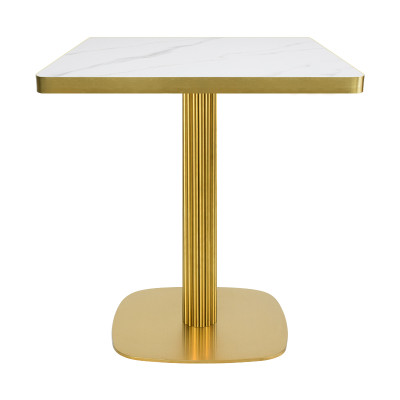
Table Bases: 5 Material Options with Full‑range Processes
| Material | Features & Applications |
| Brushed / mirror finishes, rust‑resistant. Ideal for high‑end restaurants, hotels and outdoor dining spaces | |
| Light‑weight yet high‑strength; anodized surface options. Fits modern‑style and movable furniture | |
| Superior load‑bearing capacity, classic elegant look. Suited for banquet halls and heavy‑style venues | |
High production efficiency, cost‑effective for mass‑standardized products | |
Mature welding & spraying processes, cost‑competitive for mainstream commercial & residential furniture |
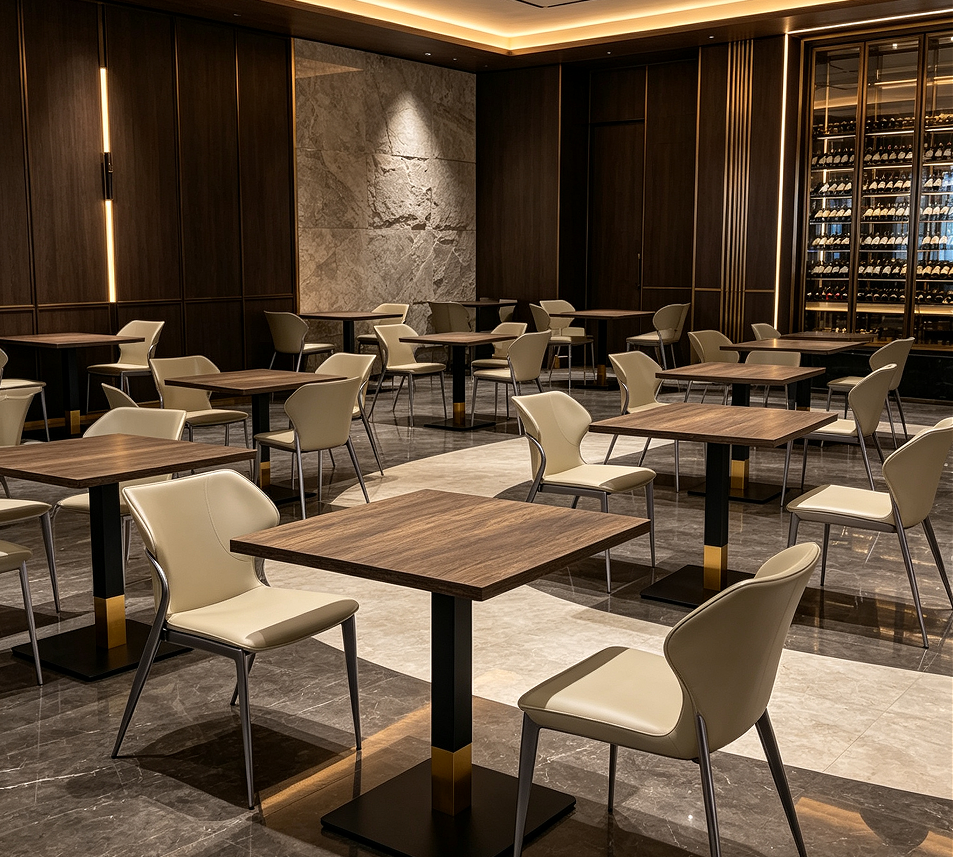
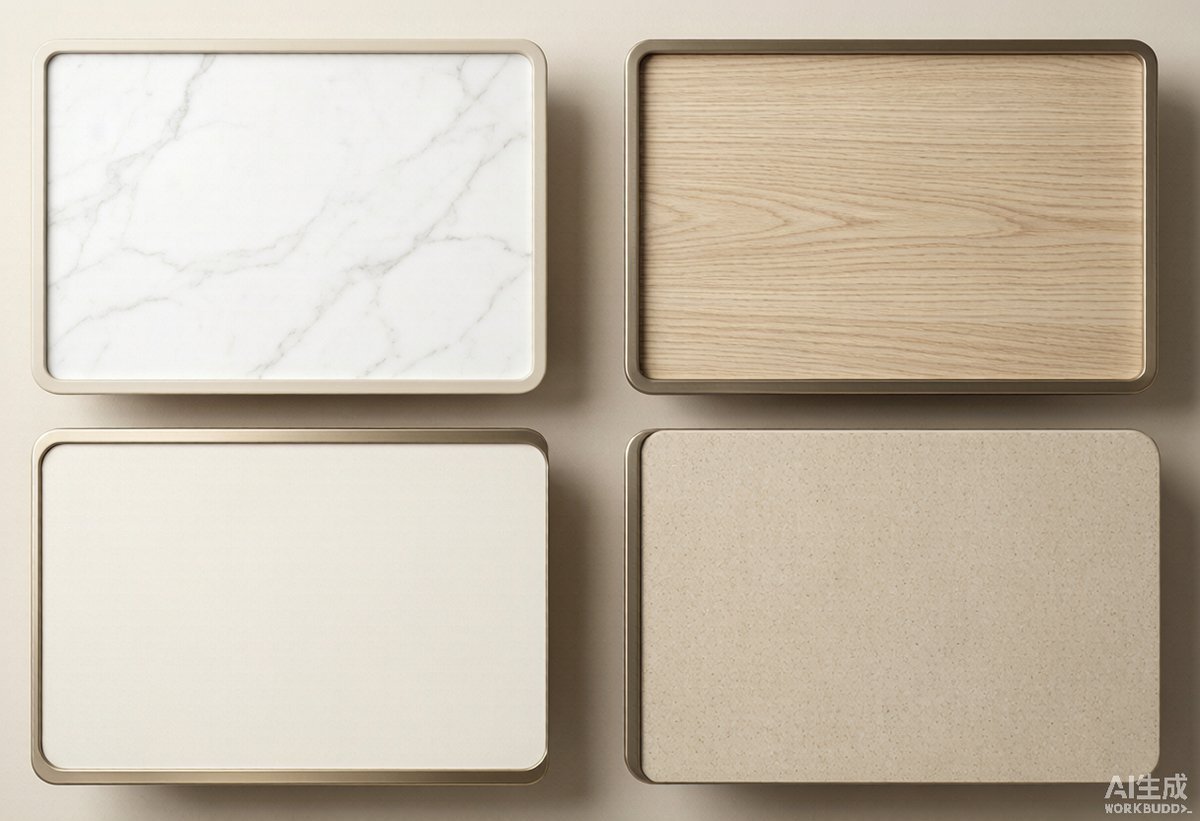
Tabletops: 4 Material Choices for Different Budgets & Styles
| Tabletop Material | Features & Applications |
| Heat‑resistant, scratch‑proof, large‑format slabs. Top choice for premium hospitality and luxury residential projects | |
| Controllable veining patterns, cost‑friendly for mid‑tier restaurants and banquet halls | |
| Natural warm texture, customizable wood species and grain for Nordic & Japanese‑style interiors | |
Stain‑resistant, rich color options. Perfect for high‑traffic quick‑service restaurants |
Complete Dining Sets: One‑stop Delivery
Beyond table bases and tabletops, AEONTI delivers complete dining‑set solutions. Table frames, tabletops and chairs are designed and matched in‑house, eliminating dimensional mismatches and style inconsistencies caused by multiple suppliers. One order, one accountable partner, one container loading.
Reasons to Choose AEONTI
1. Real factory: In‑house production lines. OEM & ODM support for custom drawings & samples. Virtual factory tour available.
2. Full‑product portfolio: 5 table‑base materials, 4 tabletop materials and complete dining‑set solutions for one‑stop procurement.
3. Rich export experience: Familiar with international packaging, sea‑freight and target‑market quality requirements for worry‑free delivery.
4. Traceable quality: Full‑process control for welding, surface finishing and load‑bearing tests. Production‑team direct contact for issue resolution.
FAQ
Q1: What is AEONTI’s MOQ?
A: MOQ varies with materials and processes. Reasonable MOQ applies for regular metal table bases. Send us your item specifications and quantity, and we will provide formal quotation and lead‑time within 24 hours.
Q2: Can you produce according to our drawings?
A: Yes. As a manufacturer, we support OEM custom‑made per drawings and ODM custom development.
Q3: Can we get samples for quality confirmation?
A: Yes. Sampling will be arranged after drawing confirmation. Mass production starts only after sample approval.
Q4: How do you guarantee export‑grade packaging and lead‑time?
A: We have extensive export experience and provide sea‑worthy reinforced packaging. Definite production schedules and shipment timelines will be offered based on order volume.
Q5: Can I order sintered‑stone tabletops and metal table bases together?
A: Absolutely. This is one of our core strengths. Tabletops and table bases are matched in‑house with precise dimensions and unified styling, delivered within one single shipment.
Turn Procurement into Long‑term Competitiveness
Choosing between a manufacturer and a supplier is essentially a trade‑off between short‑term pricing and long‑term value. If you want:
‑ Factory‑direct pricing free of middle‑man markup
‑ Continuous R&D and customization support for product iteration
‑ Stable, traceable quality and reliable lead‑time
Welcome to contact AEONTI. Send us your drawings, samples or product photos. Our engineers will evaluate technical feasibility and prepare quotations for you within 24 hours.
📞 WhatsApp: +86 17841353079
📧 Email: aeonti@aeonti.com
🌐 Website: www.aeonti.com