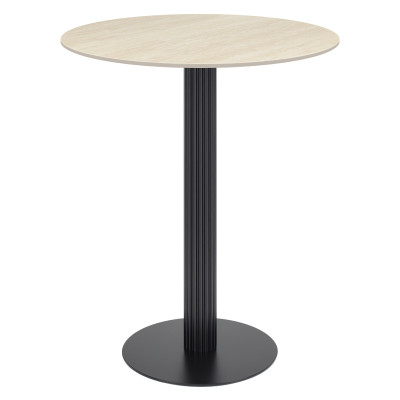
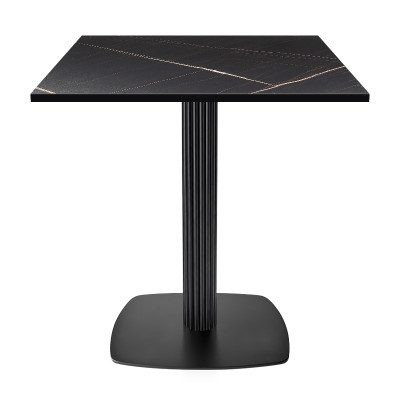
A table placed by the sea looks much like any other table. But for restaurant owners, furniture wholesalers, hotel project buyers and contractors, the real question is never whether a table looks good. It is whether 50, 100 or several hundred of them can withstand sea wind, salt spray, rain, sunlight and daily high-frequency use — and whether the same product can still be supplied a year later.
For B2B procurement, one wrong table may mean a return. One wrong project order can mean repurchasing, on-site rework, freight cost and project delays. A seaside table worth buying in bulk is rarely the cheapest-looking product. It is a product that performs in a real commercial environment and can be supplied consistently at scale — starting with the table base underneath.
The better first question: instead of asking only "How much?", ask "Where will this table be used, and what configuration do you recommend for this environment?" The two questions sound similar but represent completely different procurement thinking.
1. Before comparing prices: what a coastal table actually faces
Most buyers compare tabletop price, table base price, set price, MOQ and who offers the lowest quote. Those matter — but coastal projects carry costs that never appear on a quotation: salt-spray corrosion, rain erosion, sun exposure, frequent moving, uneven floors, strong wind, cleaning and long-term high-frequency commercial use.
Commercial outdoor furniture faces a far harsher environment than residential furniture. Salt and moisture accelerate the aging of metal connectors, welded joints, surface treatments and connections between different metals. Ask a supplier for a recommended configuration, not just a number.
2. The first standard is stability, not weight
Heavier does not automatically mean more stable. A coastal table must balance tabletop size, table base size, base weight, support structure, the connection between the table base and top, floor conditions, wind, daily moving and overnight storage. A large tabletop on an undersized table base can wobble even when the base is heavy.
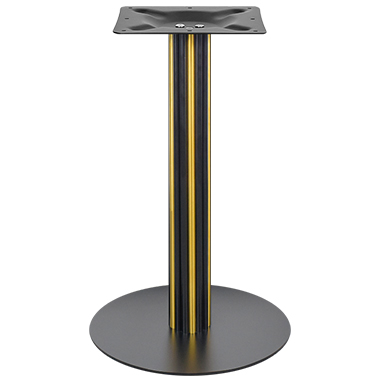
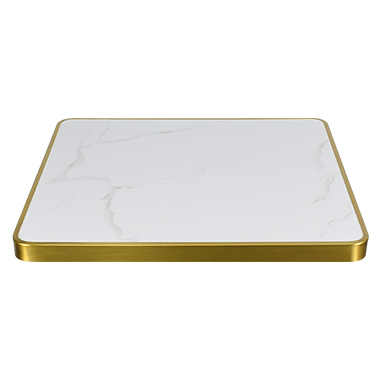
For bulk procurement: do not buy a single table base. Buy a matched tabletop + table base combination. Professional furniture procurement increasingly values complete-system matching over one material or one part.
3. Material matters in a coastal environment
Products can look identical in photos and perform completely differently after months outdoors. The right question is not "which material is best?" but "which material suits my project environment?"
Aluminum alloy — for projects that need to move
If staff clear tables, adjust seating, change layouts, move furniture or store seasonally, an aluminum table base is worth considering. It is relatively light and does not develop the traditional red rust of ordinary steel. But it is not problem-free: check alloy specification, structural strength, surface treatment, welds and joints, hardware and actual outdoor conditions. Evaluate the complete structure — see the aluminum table base range.
304 stainless steel — for high-humidity, high-salt-spray sites
For beachfront, seaside and coastal restaurants close to the water, a 304 stainless steel table base often enters the shortlist. But "stainless steel" is not one performance level: grade, fabrication, weld location, finish and maintenance all affect the result. Ask "What stainless steel grade and finish do you recommend for coastal use?" — then confirm material, joining method and maintenance together.
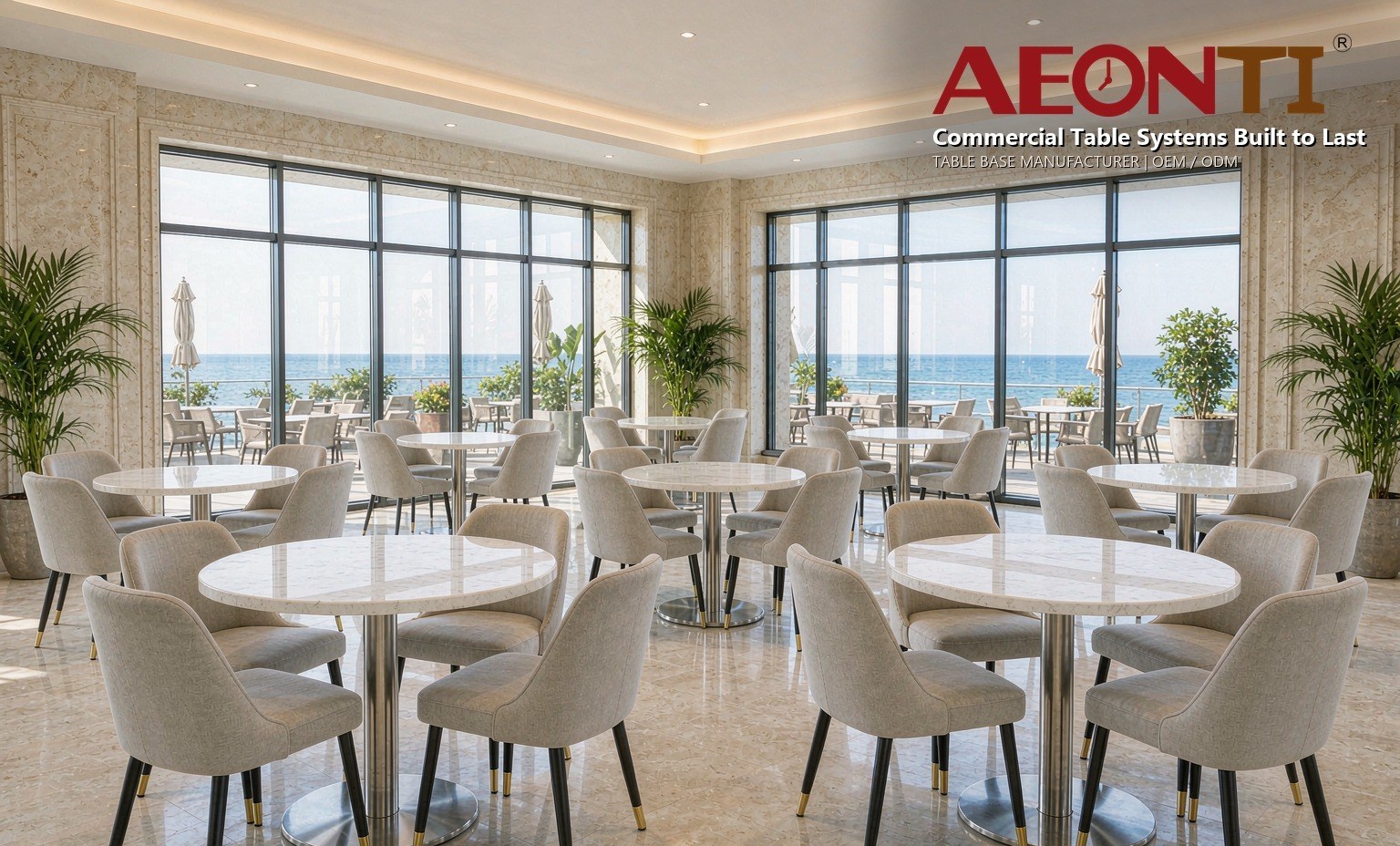
Controlled interiors can use a premium finish: brushed stainless steel table bases paired with stone tops. Keep one visual language across indoor and outdoor zones with indoor-outdoor table systems.
4. The weak points are usually under the tabletop
Buyers spend most attention on the top — wood grain, stone colour, size and edges. Long-term performance is often decided underneath.
- Table Base — stability and load support
- Mounting Plate — tabletop compatibility and hole alignment
- Fasteners — safety, corrosion resistance and maintenance
- Welded Joints — structural life under daily use
- Leveling Glides — floor adaptability and wobble prevention
These parts affect stability, installation efficiency, tabletop compatibility, floor adaptability, long-term maintenance and future replacement. A commercial outdoor table is not just a top plus a table base. Discuss an engineered dining-table solution rather than loose parts.
5. Never ignore wind on a coastal project
Beach restaurants, rooftop restaurants, oceanfront cafés, resort terraces, open-air bars and seaside dining areas all face wind as a real purchasing factor. If the top is too large, the table base too small and the unit too light, stability must be re-evaluated. But heavier is not always better: if staff move 100–200 tables a day, excess weight adds labour cost.
Balance: stability + mobility + environment + tabletop size. Exposed zones often need a heavier cast iron table base or a wide-footprint twin-column design; daily reconfiguration favours a lighter aluminum table base.
6. The real risk is not paying more once — it is not getting the same thing twice
Furniture wholesalers, restaurant chains, hotel groups, project contractors and furniture brands know this problem: you buy 100 sets, and a year later a client needs 30 more. Can the supplier reproduce them exactly — dimensions, colour, finish, table base structure, mounting holes, tabletop spec, packaging and quality?
A long-term partner is not only "a factory that can produce" but "a manufacturer that can reproduce consistently". For restaurant groups and hotel projects this matters more than a few percentage points on the first order. AEONTI maintains stable specifications and a 7-stage quality control system.
7. Why a cheap table can end up costing more
Supplier A quotes $100 per set; Supplier B quotes $108. Most buyers choose A. But if A later delivers finish problems, a wobbling table base, dimensional deviations, inconsistent batches and difficult reorders, the true cost far exceeds the $8 saved.
| Hidden cost after a cheap purchase | Business impact |
|---|
| Rework and replacement | Labour and material to fix on site |
| Logistics | Return freight, re-shipping and handling |
| Project delay | Missed opening dates and possible penalties |
| Customer complaints | Damage to reputation and repeat business |
| After-sales support | Ongoing cost long after the invoice |
Compare TCO, not purchase price. For B2B — especially coastal commercial projects — compare Total Cost of Ownership. Stable quality, reliable lead time and repeat-order consistency save more over three to five years than a slightly lower opening quote.
8. Seven questions to screen a supplier
Send these to every candidate. A supplier who can only say "our price is cheap" has not answered them.
- What material do you recommend for a coastal restaurant project?
- What table base do you recommend for my tabletop size and weight?
- What surface treatment is used for the metal table base?
- Is the complete table suitable for my actual outdoor environment?
- Can you provide samples before bulk production?
- Can you keep the same specifications and finish for future reorders?
- Can you customize the table base, tabletop size, finish or mounting solution?
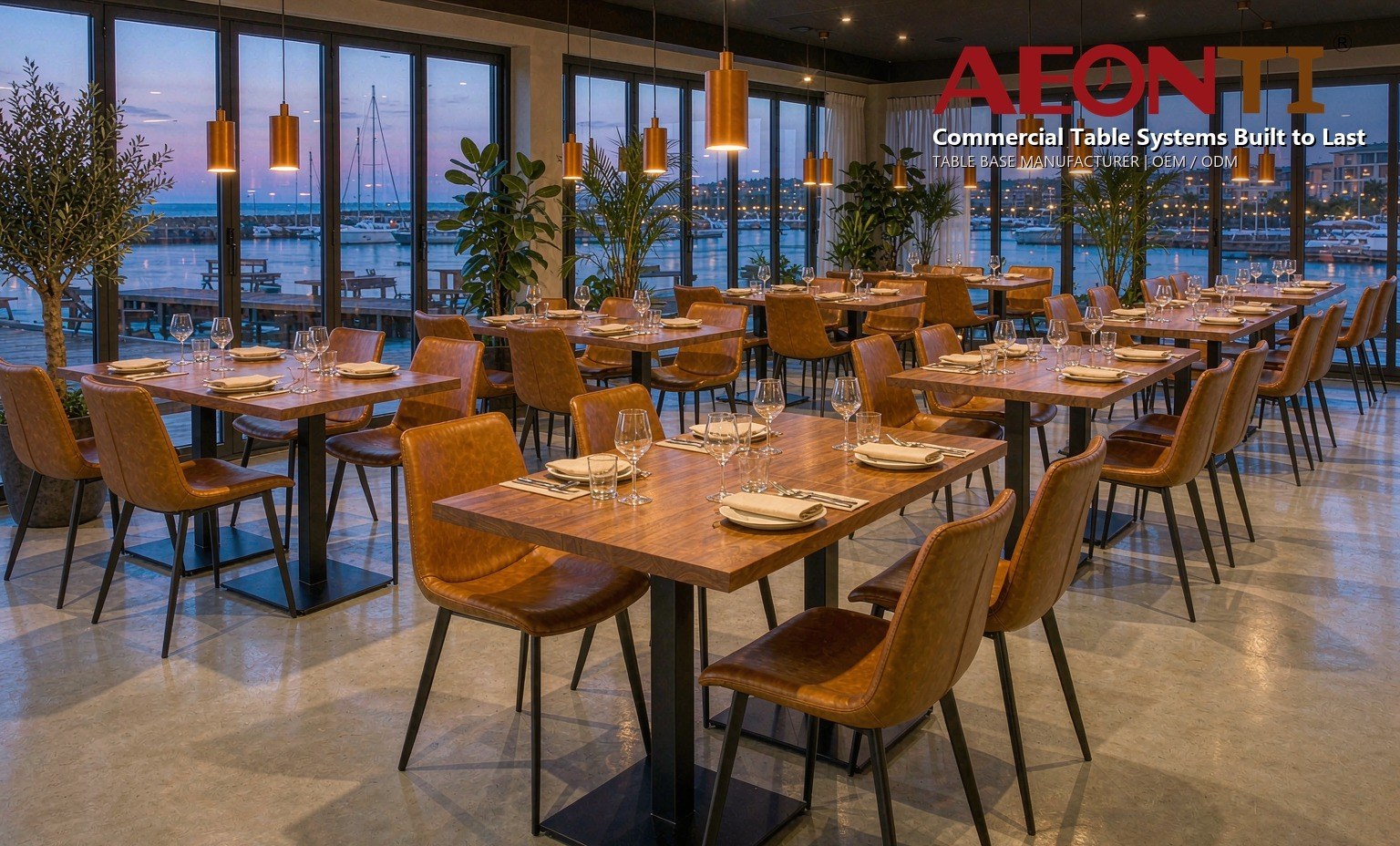
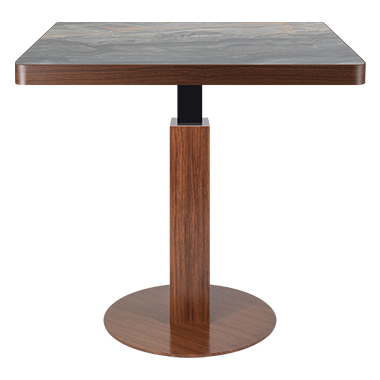
A matte-black iron table base supports walnut tops in a high-throughput bistro. Plan complete sets with the online table configurator.
9. Wholesalers: buy a product range, not a single SKU
Clients rarely need only one table. They may ask for 600×600mm, 700×700mm or 800×800mm; round, rectangular, dining, café or bar tables — often together. A stronger offer is one table base series, multiple tabletop options and sizes, different finishes and genuine OEM / ODM capability.
That lets a wholesaler combine products for each client's restaurant style and budget. For B2B buyers, supply-chain flexibility is part of the product's value. AEONTI's range spans stainless steel, iron, cast iron and aluminum table bases — see the wholesale program.
10. What standard should a seaside table worth buying meet?
A table worth buying in bulk is not necessarily the most expensive or the heaviest. It is matched to the environment, structurally stable, sensibly specified in material and finish, easy to maintain and consistently supplied. Check each line:
| Procurement item | What B2B buyers must focus on |
|---|
| Tabletop | Material, size, moisture resistance, outdoor suitability |
| Table Base | Material, structure, stability, size matching |
| Surface treatment | Outdoor suitability and corrosion resistance |
| Installation | Mounting holes, compatibility and efficiency |
| Stability | Tabletop size, base size and wind conditions |
| Mobility | Product weight and daily handling needs |
| Bulk production | Product consistency and quality control |
| Reordering | Long-term specification consistency |
| Customization | Size, colour, finish and structure |
| Packaging | Long-distance shipping and container loading |
| After-sales | Spare parts, reorders and technical support |
11. If your project is by the sea, ask one better question
Instead of "What's your best price?", try: "We are sourcing commercial dining tables for a coastal restaurant project. Can you recommend the right tabletop and table base configuration based on our environment, table size and quantity?"
This question makes a real B2B supplier focus on environment, quantity, tabletop size, table base configuration and long-term use — not just send a flat price list.
12. AEONTI can build your table project starting with the table base
Table procurement for restaurants, hotels, cafés, wholesalers and project buyers does not have to be locked into one standard model. If your project needs Commercial Table Bases, Restaurant Table Bases, Metal Table Bases, Stainless Steel Table Bases, Aluminum Table Bases, Cast Iron Table Bases, Custom Table Bases, commercial dining tables, different tabletop options or OEM / ODM Solutions, the discussion should be about configuration — not just unit price.
AEONTI specializes in commercial dining tables and table bases with different materials, sizes, structures and finishes. For a beach restaurant, coastal café, hotel resort, outdoor dining project or furniture wholesale business, send quantity, tabletop size, environment, target material and project photos. We will help shortlist the right table base and table combination.
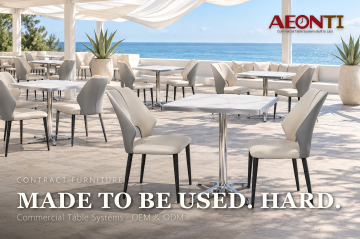
Rust-proof aluminum table bases on an open seaside terrace — part of our outdoor patio table systems.