Pedestal Table Bases vs. Four-Leg Table Bases: Pros, Cons & Best Applications
When shopping for a table, most people focus on the tabletop material, size, and color first — often overlooking a critical component that profoundly impacts the overall user experience: the table base. The table base not only determines a table's stability but also directly affects space utilization, seating flexibility, and the overall visual aesthetic.
The two mainstream table base categories on today's market are Pedestal Bases and Four-Leg Bases, along with their derivatives — Cross Bases, T-Bases, and round Bases. This article systematically examines the structural characteristics, advantages and disadvantages, and best application scenarios for each type, helping you make the most informed choice.
What Is a Pedestal Table Base?
A pedestal base, as its name suggests, relies on a single column positioned at the center of the table for support. The bottom of the column is typically connected to a round, square, or cross-shaped footplate to distribute weight. This structure is commonly found on round tables, small coffee tables, bar-height tables, and certain modern dining tables.
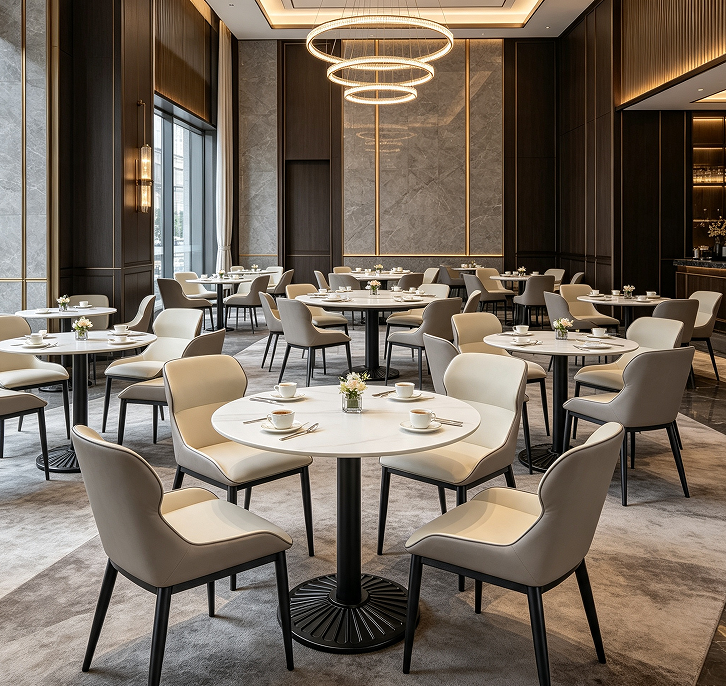
The defining characteristic of a pedestal base is single-point support — all weight-bearing and stabilization tasks are concentrated on the central axis. Common materials include metal (stainless steel, cast iron) and wood-metal combination structures.
What Is a Four-Leg Table Base?
The four-leg base is the most traditional and widely used table leg structure. It consists of four independent legs, typically connected by crossbeams or a frame to enhance overall rigidity. This type of base is commonly found on rectangular dining tables, office desks, conference tables, and other settings where stability is paramount.
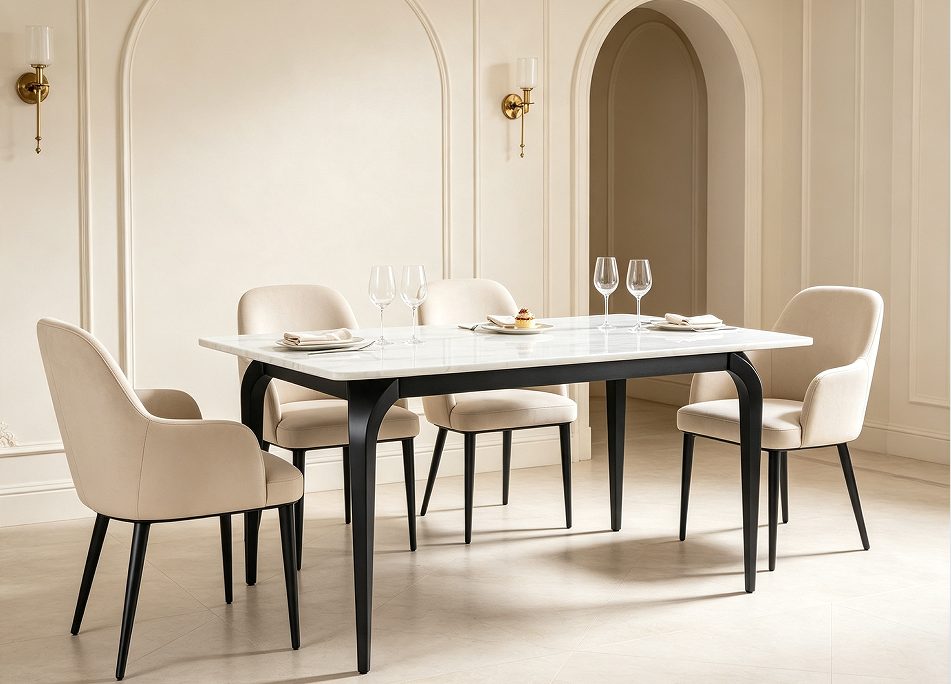
The core principle of a four-leg base is distributed support — transferring the tabletop's weight evenly across four points to the floor. Each leg is typically positioned near a corner of the tabletop, forming a stable rectangular support frame.
Pedestal Table Bases — Advantages and Limitations
Advantages
| Advantage | Description |
| Ample legroom | Without corner legs obstructing movement, diners can sit anywhere around the table without bumping into legs — especially ideal for round table gatherings |
| High seating flexibility | Unrestricted by fixed leg positions, you can freely add or remove chairs as needed without the "one person per corner" limitation |
| Clean visual appearance | The single-column structure creates uncluttered lines with no visual noise, making it especially suitable for modern minimalist and Scandinavian interior design |
Easy to clean | With only one contact point on the floor, sweeping and mopping require no maneuvering around four legs — simpler daily maintenance |
Perfect for round tables | Round tabletops and pedestal bases are a natural pairing, offering structural harmony with a centered center of gravity |
Limitations
| Limitation | Description |
| Stability under extreme conditions | When the center of gravity shifts excessively (e.g., heavy objects concentrated at the table edge), single-column structures offer less tipping resistance than four-leg designs |
| Not ideal for extra-long tabletops | Long rectangular tables (such as conference tables over 2 meters) with pedestal bases may experience uneven force distribution at both ends |
Four-Leg Table Bases — Advantages and Limitations
Advantages
| Advantage | Description |
| Exceptional stability | Four-corner support forms a stable rectangular frame — the table is unlikely to wobble or tip even under uneven local force on the tabletop |
| Ideal for rectangular tabletops | Four legs can be precisely distributed at each corner of a long table to provide even support, making this the top choice for large dining tables and office desks |
| Strong load-bearing capacity | Multi-point distributed support enables four-leg bases to handle greater total weight, suitable for heavy solid wood or stone tabletops |
Easy to disassemble and transport | Most four-leg tables allow leg removal for flat-pack shipping, making them convenient for transport, relocation, and warehousing |
Versatile style compatibility | From classic European to industrial vintage, four-leg bases integrate easily into a wide range of decor styles with the highest market acceptance |
Limitations
| Limitation | Description |
| Restricted legroom | Corner legs limit seating positions — people sitting near corners may frequently bump into the table legs |
| Fixed seating capacity | Four legs naturally cap seating along four sides, offering less flexibility than pedestal structures |
| Slightly more effort to clean | Sweeping requires navigating around four legs and any crossbeam structure, adding steps to daily cleaning |
Stronger visual presence | In smaller spaces or when pursuing a minimalist aesthetic, four-leg structures may feel visually "crowded" |
Cross Table Bases — A Hybrid Solution
The cross base is an important variant of the pedestal base. It features a cross-shaped footplate installed at the bottom of the central column, with two intersecting metal or wooden beams forming an X-shaped footprint on the floor.
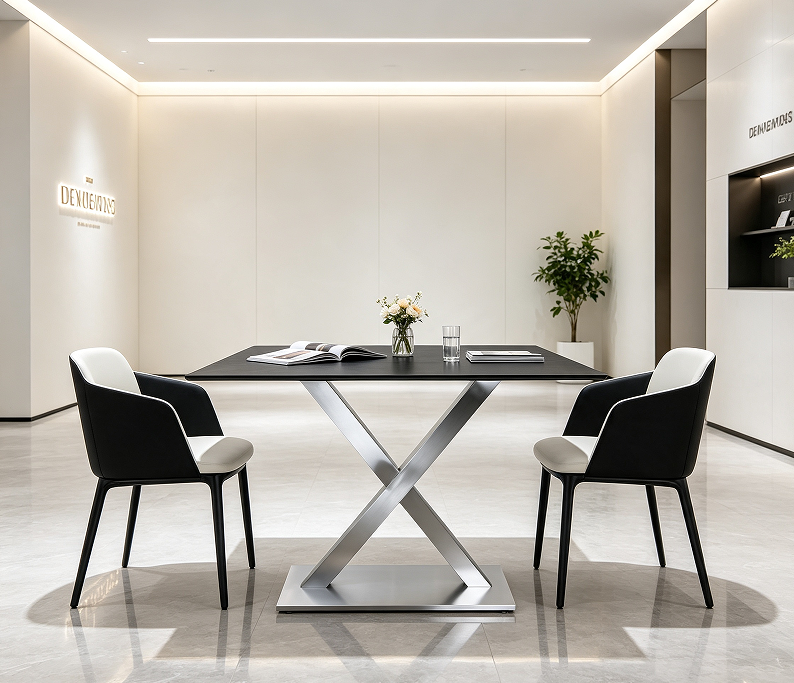
The cross base strikes a balance between space-saving and stability. Compared to a pure pedestal base, the cross base significantly improves tipping resistance by extending the bottom support surface. At the same time, compared to a four-leg base, it retains better legroom and visual simplicity.
This structure is commonly found on office chair bases, small round tables, and modern-style dining tables. If you want the leg freedom of a pedestal but worry about stability, the cross base is well worth considering as an alternative.
T-Base Table Bases — Space-Saving Design
The T-base features a uniquely distinctive structure: a horizontal bar foot connected at the bottom of a vertical column, forming a "T" shape when viewed from the side. This horizontal bar foot is typically aligned parallel with the long edge of the tabletop.
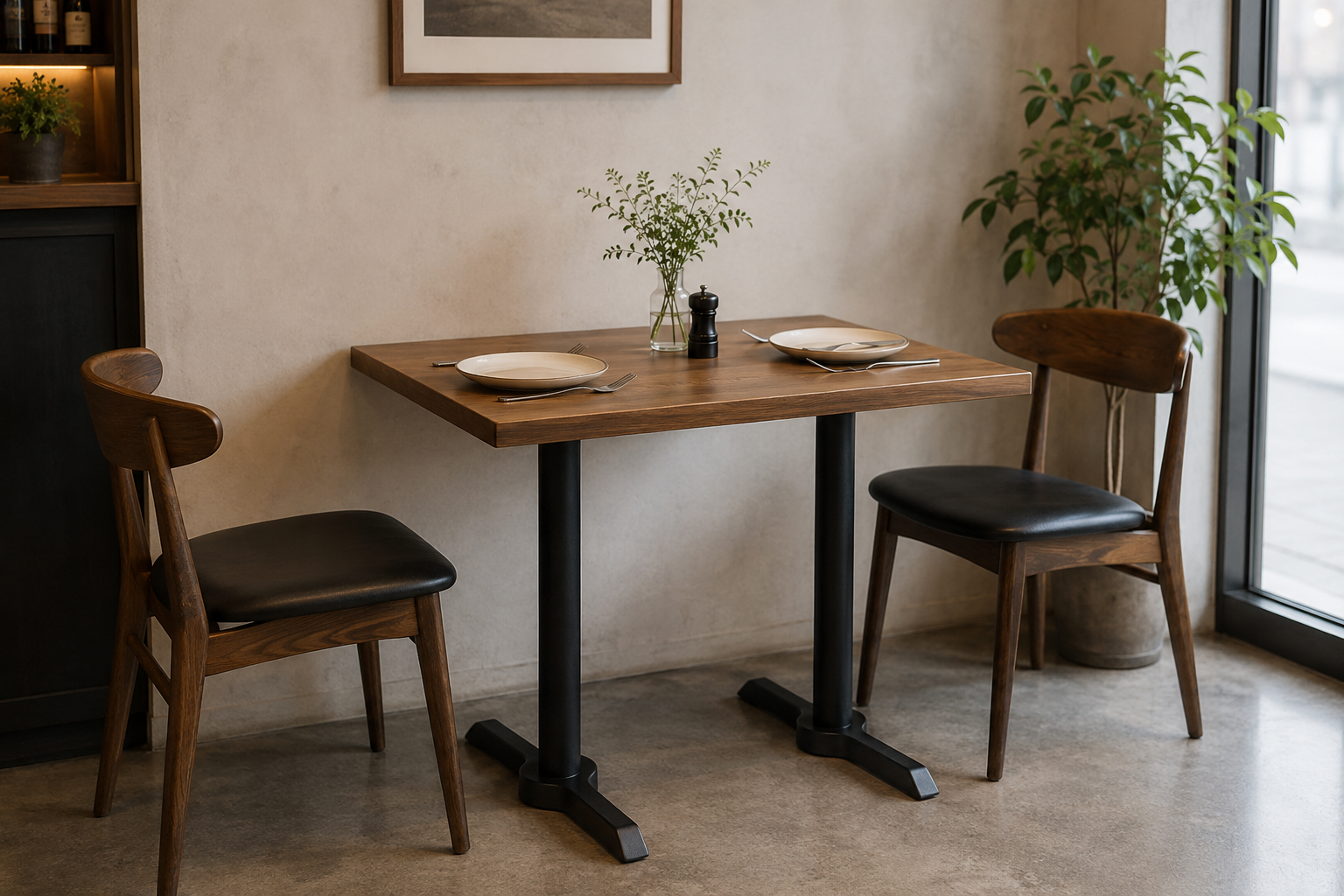
The disc base's aesthetic value often outweighs its functional value. Although the disc footplate has a relatively large diameter (typically 50–70 cm), its flat profile does not significantly interfere with foot space. Disc bases are ideally suited for high-end restaurants, exhibition display stands, and lobby coffee tables — environments where visual impact is a priority.
Disc bases are commonly made from stainless steel, chrome-plated metal, or marble, and pair exceptionally well with glass or stone tabletops. However, it is worth noting that disc bases may be less stable on thick carpets compared to other structures.
Recommended Table Bases for Different Scenarios
Which base structure to choose ultimately depends on your usage scenario. Below is our recommendation guide based on different dimensions:
| Scenario | Recommended Base Type | Reasoning |
| Small round table (2–4 people) | Pedestal Base / Disc Base | High space efficiency, clean visual, flexible seating |
| Medium round table (4–6 people) | Cross Base / Pedestal Base (wide footplate) | Balances stability and legroom |
| Large rectangular dining table (6–10 people) | Four-Leg Base | Long tabletops need four-corner support for best stability |
Office desk / Conference table | Four-Leg Base / T-Base | Strong load-bearing, structurally stable, suitable for long-term use |
Café two-person table | T-Base / Pedestal Base | Space-saving, easy customer access |
Bar table / High-top table | Bar table / High-top table | High center of gravity needs centered support, visually lightweight |
Outdoor patio table | Four-Leg Base / Cross Base | Good wind stability, adapts to uneven ground |
Good wind stability, adapts to uneven ground | Disc Base | Strong design appeal, elevates the space's aesthetic |
Extendable / Folding table | Four-Leg Base | Easy to disassemble, convenient for storage and transport |
Selection Decision Tree
If you are still unsure which base to choose, follow this decision path for a quick determination:
| Step | Condition | Yes → | No → |
| ① | Is the tabletop rectangular and longer than 1.8 meters? | Four-Leg Base | Go to ② |
| ② | Is legroom and seating flexibility your top priority? | Go to ③ | Four-Leg Base |
| ③ | Do you require extremely high tipping resistance? | Go to ④ | Pedestal Base |
④ | Can you accept slightly higher cost and a clean visual look? | Cross Base | T-Base |
Rating Comparison by Dimension
| Dimension | Pedestal Base Wins | Four-Leg Base Wins |
| Legroom | ★★★★★ | ★★☆ |
| Stability | ★★★☆ | ★★★★★ |
| Seating flexibility | ★★★★★ | ★★☆ |
Suitability for long tables | ★★☆ | ★★★★★ |
Suitability for round tables | ★★★★★ | ★★★☆ |
Visual simplicity | ★★★★★ | ★★★☆ |
Ease of cleaning | ★★★★★ | ★★★☆ |
Choosing the Right Table Base Structure for Your Business
For furniture dealers, restaurant operators, interior designers, and wholesale buyers, choosing a table base is not merely a matter of aesthetic preference — it is a comprehensive decision involving usage scenarios, target customers, and supply chain considerations.
1. Identify Your Target Usage Scenario
First, ask yourself: where will this table ultimately be used? Residential homes, restaurants, office spaces, or outdoor settings? Different scenarios have completely different requirements for base stability, space efficiency, and durability.
2. Match Consumer Preferences
North American market: Prefers large four-leg dining tables, emphasizing solidity and traditional styling
European market: Favors the minimalist design of pedestal and disc bases, especially in Scandinavian-style homes
Asian market: Compact housing drives demand for space-saving solutions such as pedestal bases and T-bases
3. Choose a Reliable Supplier
Whatever type of table base you select, finding a quality and dependable supplier is critical. As a professional pedestal table bases supplier, we offer a full range of products including pedestal bases, T-bases, disc bases, and four-leg bases. We support custom pedestal table base manufacturing and pedestal table bases wholesale services.
Our product line also includes cross table bases supplier, t-base table bases supplier, disc table bases supplier, disc table bases wholesale, and column table bases supplier / column table bases wholesale services — catering to the diverse needs of different markets and projects.
Summary
| Base Type | Core Advantage | Best Scenarios | Notes |
| Pedestal Base | Ample legroom, flexible seating, clean visual | Round tables, small dining tables, bar tables | Less portable, not ideal for extra-long tabletops |
| Four-Leg Base | Exceptional stability, high load capacity, easy disassembly | Rectangular dining tables, office desks, conference tables | Restricted legroom, slightly more cleaning effort |
| Cross Base | Balanced compromise, better stability than pure pedestal | Small to medium round tables, office chair bases | Slightly higher cost than standard pedestal |
T-Base | Ultimate space-saving, strong contemporary feel | Wall-side tables, bar counters, two-person dining tables | Ultimate stability less than cross or four-leg |
Disc Base | Outstanding design appeal, minimalist aesthetic | Display stands, high-end restaurants, lobby coffee tables | Slightly less stable on thick carpets |
There is no absolute "best" when it comes to table bases — only the most suitable. We hope this systematic comparison helps you make an informed decision for your next project. If you have any procurement or customization needs regarding table bases, please feel free to contact us.
📞 WhatsApp: +86 17841353079
📧 Email: aeonti@aeonti.com
🌐 Website: www.aeonti.com