Home / All / Buying Guides / How to Reduce the Landed Cost of Commercial Table Bases Without Sacrificing Quality
How to Reduce the Landed Cost of Commercial Table Bases Without Sacrificing Quality
Oct 30,2026
For restaurants, hotels, cafés, furniture wholesalers, furniture distributors and commercial project buyers, the factory quotation is often only part of the true cost when purchasing commercial table bases.
Suppose one factory quotes USD 20 per set and another quotes USD 23. The first looks cheaper. But if the first supplier's table bases are bulkier, pack less efficiently, load fewer sets per container, or require more labor to assemble and more cost to transport, the actual cost of getting them into your warehouse may end up higher.
That is why professional B2B buyers increasingly focus on Landed Cost — not just the product unit price. For large-volume commercial furniture procurement, what is truly worth optimizing is not any single cost item, but the entire supply chain: product design, materials, packaging, container loading and shipping.
This article explains how to reduce the overall landed cost of commercial table bases without sacrificing product quality or performance.
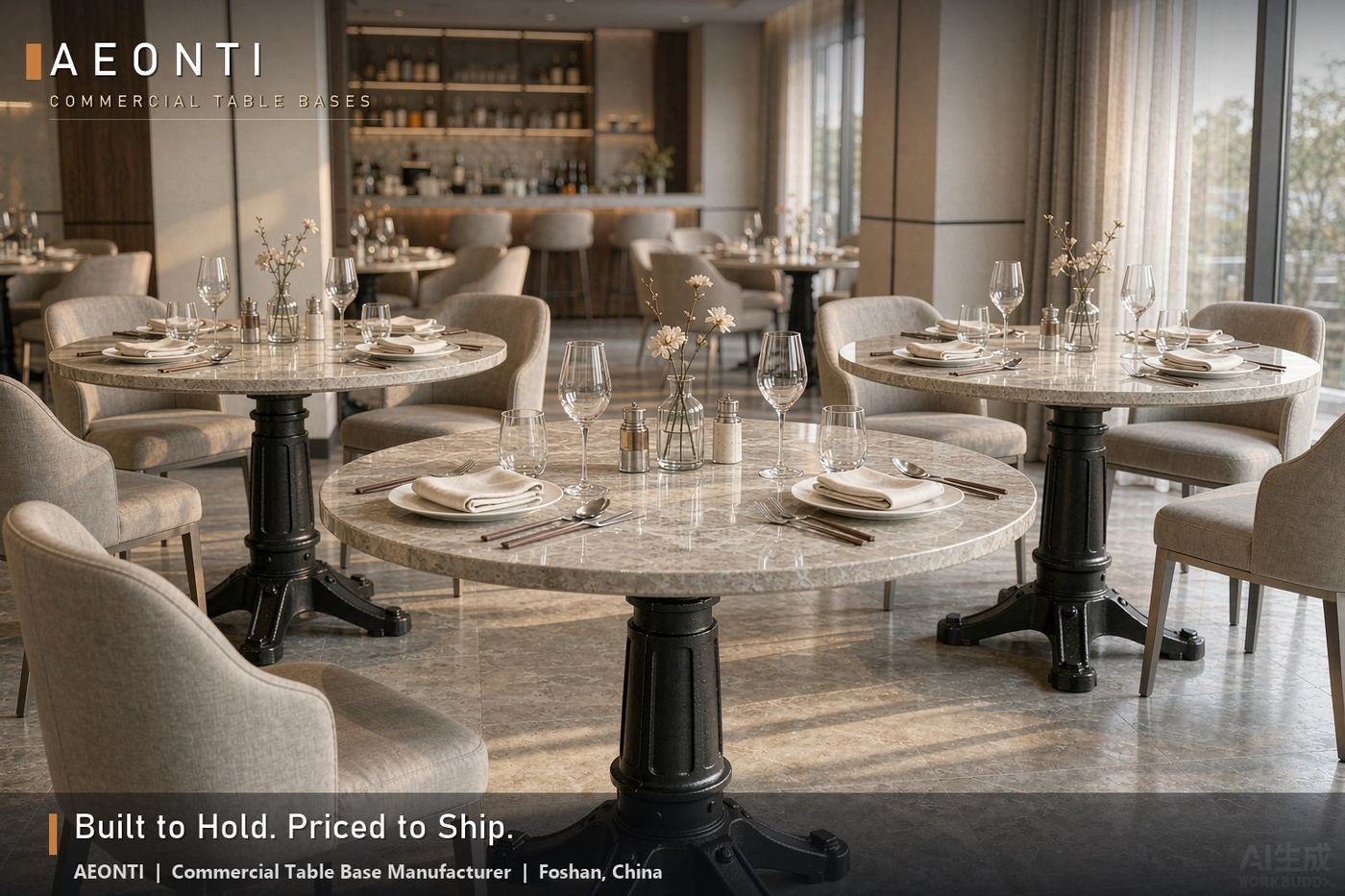
Heavy-duty commercial table bases in daily restaurant use — built for hospitality projects.
So what a buyer should really compare is not "which factory has the lowest unit price", but "how much does this product actually cost when it arrives at my warehouse".
For commercial table bases — products that are typically bulky and heavy — transportation and packaging have an especially strong impact on the final cost.
02 What Makes Up the Landed Cost?
The landed cost of commercial table bases usually includes five components.
1. Product Cost
The most visible cost: raw materials and steel tubes, welding, stamping, casting, surface finishing, labor and factory profit. Different product designs mean different product weights and different material consumption.
2. Packaging Cost
Packaging is more than the price of a carton. It also includes export cartons, foam, corner protectors, pallets and other protective materials. For large-volume orders, an extra USD 0.5 of packaging cost per set means an extra USD 500 per 1,000 sets.
3. Inland Transportation
The cost of moving goods from the factory to the port must also be counted. If the packaging volume is large, trucking costs can rise even when the product itself is not particularly heavy.
4. Ocean Freight
Ocean freight is usually one of the most significant cost items. For table bases in particular, freight depends not only on weight but also on CBM (cubic meters), container type, container utilization, shipping route and FCL or LCL mode.
5. Import Duties and Destination Charges
After arrival, additional charges may include import duty, customs clearance, port charges, handling fees, delivery fees and warehouse charges.
Landed cost components — and where a professional supplier helps
Value-engineered table base designs with OEM and ODM support
Packaging
Carton size, foam, pallets
Right-sized export cartons, foam and corner protection designed around each model
Ocean freight
CBM and container utilization
Nesting structures, flat-pack options, container loading plans before production
Destination charges
Port, customs, handling
Complete export documentation and FCL planning to reduce handling
Buyers should therefore build a complete landed cost model instead of comparing FOB or EXW unit prices alone.
03 How Product Design Affects Shipping Cost
Product design itself affects transportation cost. Two commercial table bases may be functionally similar, yet their packaging volumes can differ dramatically because of structural design.
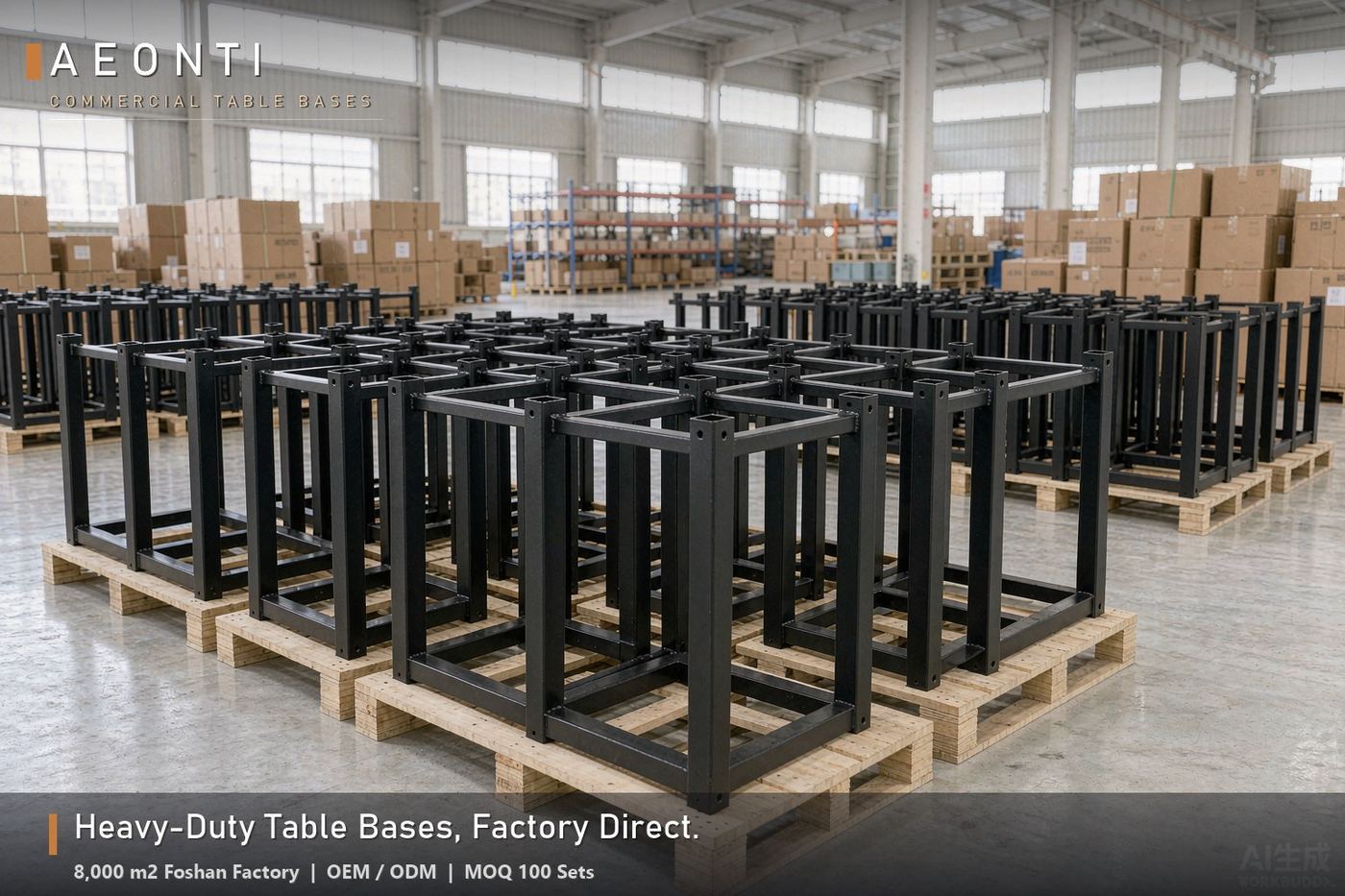
AEONTI's 8,000 m² Foshan factory — table base production, stacking and export palletizing under one roof.
Product dimensions
Larger base plates (400 × 400 mm, 450 × 450 mm, 500 × 500 mm) occupy more packing space and reduce stacking efficiency. Right-size the plate for the application instead of defaulting to the largest footprint.
Product structure
Fixed, fully welded structures occupy more space; knock-down structures reduce shipping volume where stability allows.
Tube design
Irrational tube lengths and connection methods waste packaging space. Optimized lengths and joints remove dead space.
Nesting design
Table bases that nest into each other significantly increase units per carton; non-nesting designs leave air gaps in every box.
Considering logistics efficiency at the product development stage is far more effective than trying to reduce freight after production is finished.
04 Flat-Pack vs Assembled Table Bases
For commercial table bases, flat-pack and assembled packaging are the two most common delivery methods.
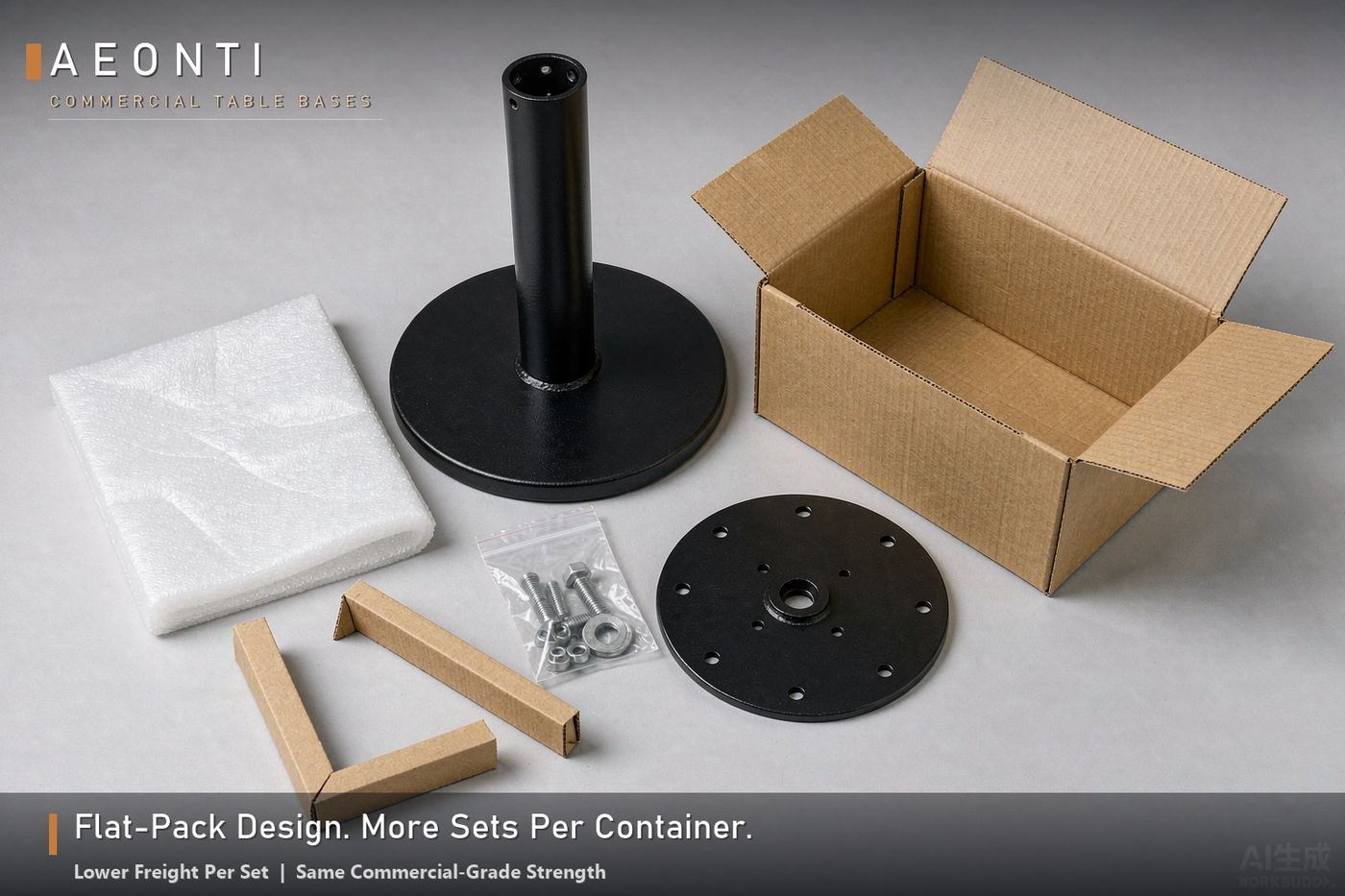
A flat-pack table base kit: column, base plate, mounting plate, hardware, foam and corner protectors — one carton, minimal air.
Assembled vs flat-pack commercial table bases — a buyer's comparison
Aspect
Assembled Table Bases
Flat-Pack Table Bases
Delivery condition
Main assembly completed at the factory
Partially knocked down for packing
Installation
Simple — ready to use on arrival, less on-site assembly time
Final assembly required; demands better structural design and clear instructions
Packaging volume
Larger cartons, fewer sets per box
Reduced volume, more units per carton
Container utilization
Lower
Higher — lower freight cost per set
Best for
Projects needing fast installation
Volume orders where logistics cost matters
For bulk purchasing, if the product structure allows it, a well-executed flat-pack design can significantly reduce logistics cost.
Never trade strength for volume
Reducing shipping volume must not come at the cost of stability. Table bases must still meet stability, load capacity, welding strength, structural integrity and long-term durability requirements. A good supplier finds the balance between product structure and transport efficiency.
05 How Packaging Optimization Reduces Freight Cost
Packaging optimization is not simply making the box smaller. Effective packaging design considers protection, space efficiency and handling efficiency at the same time.
Individual Export Carton
Packing each set of table bases in its own export carton reduces collisions in transit, lowers the risk of surface scratches, simplifies warehouse management and makes unboxing easy for end customers.
Foam and Corner Protectors
For the edges, base plates and finished surfaces of metal table bases, use foam, corner protectors and protective film. Powder-coated, electroplated and polished stainless steel table bases especially need protection against scratching and impact.
Carton Size Optimization
Oversized cartons create empty space, which increases volume per box, reduces sets per container and raises freight cost. Undersized cartons cause their own problems: products cannot be positioned properly, more padding material is consumed and products get compressed. Carton dimensions should be designed jointly around product structure, units per carton and container space.
06 FCL vs LCL for Commercial Table Base Orders
Choosing FCL or LCL also affects the final landed cost.
FCL vs LCL — which one fits your table base order
Aspect
LCL — Less than Container Load
FCL — Full Container Load
Order size
Small orders; no need to fill a container; lower initial purchasing risk
More handling, consolidation, documentation, warehouse and destination charges
Fewer touches; simpler, more controllable process
Freight per set
Often higher than it looks
Easier to control; higher loading efficiency
Best practice
At scale, ask your supplier to quote both LCL landed cost and FCL landed cost — not just the unit price.
07 How to Improve Container Utilization
Improving container utilization is one of the most effective ways to reduce landed cost. Suppose a container holds 1,000 sets. After structural and packaging optimization it holds 1,200 sets. Even if the factory price does not change, the ocean freight allocated to each set drops immediately.
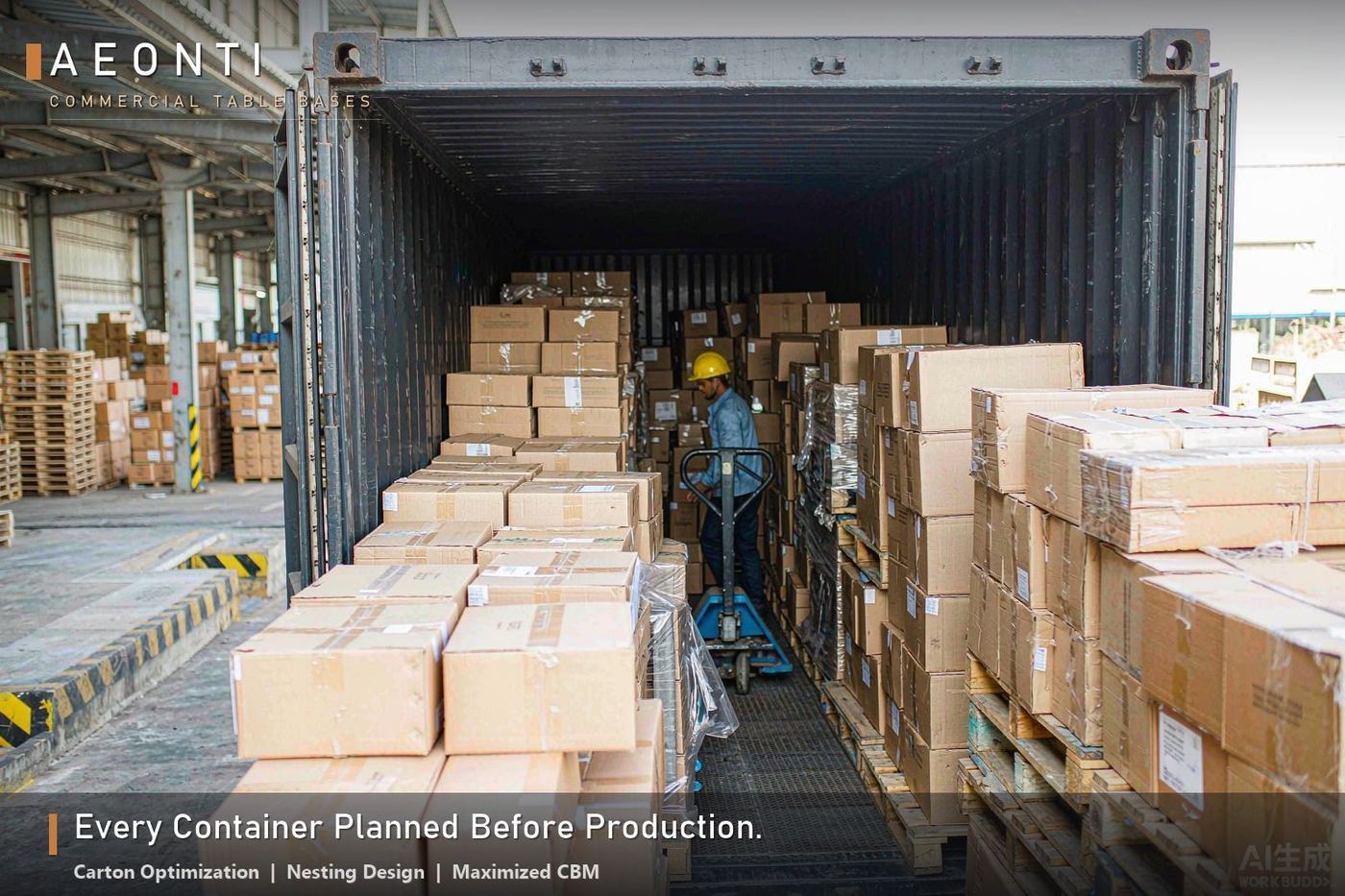
Container loading planned before production — every carton position is calculated, not guessed.
Optimize carton dimensions. Avoid oversized cartons that waste container space.
Increase units per carton. If the product structure allows, raise the units-per-carton count.
Use nesting structures. Design table base structures that nest into one another to eliminate gaps.
Combine different models. Mix sizes logically — 2-leg table bases, 4-leg table bases, pedestal table bases and bar-height table bases — to fill the container more completely.
Plan the container before production. Calculate estimated loading quantity in advance from product dimensions, carton dimensions, carton quantity, product weight and container type, so potential cost problems surface before the order is placed.
Example — container utilization vs freight per set (illustrative)
Scenario
Sets per 40ft Container
Ocean Freight
Freight per Set
Saving
Before optimization
1,000 sets
USD 4,000
USD 4.00
—
After flat-pack and carton optimization
1,200 sets
USD 4,000
USD 3.33
−17%
08 Why the Cheapest Quote May Have the Highest Landed Cost
This is one of the most common situations in commercial furniture purchasing.
Supplier A vs Supplier B — unit price vs landed cost, per set (illustrative)
Item
Supplier A
Supplier B
Product Price
$20
$22
Packaging
$1.5
$1
Freight Allocation
$5
$3
Other Costs
$1
$0.8
Estimated Landed Cost
$27.5
$26.8
Although Supplier A's product price is lower, its final landed cost is higher. Common reasons include heavier product weight, larger packaging volume, fewer sets per container, poor packing efficiency, structures that cannot be knocked down, and no container loading plan.
"The lowest factory price is not always the lowest total procurement cost." A professional purchasing decision compares the comprehensive cost of the entire supply chain.
FAQ
What is the landed cost of commercial table bases?
Landed cost is the total cost of a product from the supplier's factory to the buyer's designated location. It usually includes product price, packaging, inland transportation, ocean freight, import duties and destination charges.
How can I reduce the shipping cost of commercial table bases?
Optimize product structure, carton sizes, flat-pack design, units per carton and container utilization. For large-volume orders, improving container utilization is usually the most important lever for reducing freight per set.
Are flat-pack table bases cheaper to ship?
Generally yes. A flat-pack design reduces packaging volume and increases the number of sets per container, so freight per set can drop. The actual effect depends on the product structure and packaging method.
Is FCL cheaper than LCL for table base orders?
When order quantity is large, FCL is usually better for controlling freight per set. Always compare the real landed cost of FCL and LCL based on order volume, destination charges and shipping route.
How many commercial table bases can fit in one container?
It depends on the model, base plate size, product height, carton dimensions, units per carton and whether flat-pack packaging is used. A professional supplier can provide a loading plan based on your specific models and order quantity.
Should I choose the cheapest table base manufacturer?
Choosing on unit price alone is not advisable. The sounder approach is to compare total landed cost after product price, packaging, freight, import costs and other related charges.
What information should I provide when asking for a landed cost quotation?
Provide the product model, quantity, table base dimensions, finish, packaging requirements, delivery country, delivery city or port, and preferred shipping method, so the supplier can evaluate product, packaging and shipping costs accurately.
Final Takeaway
Reducing the procurement cost of commercial table bases does not mean choosing cheaper materials, thinner steel or the lowest quotation. Effective cost optimization follows the whole chain: product design, manufacturing, packaging, container loading, shipping and final delivery.
If a product can reduce packaging volume and increase sets per container while maintaining stability, load capacity, durability and surface quality, then even a slightly higher factory price can result in a lower final landed cost. The right question is not "who offers the lowest unit price", but "who can deliver the lowest reliable landed cost without sacrificing quality".
Get a landed-cost evaluation for your table base order
Send your models, quantities, target market and packaging requirements. Our engineering and logistics team evaluates product cost, packaging design, container loading and estimated landed cost for your actual order — not just a factory unit price.