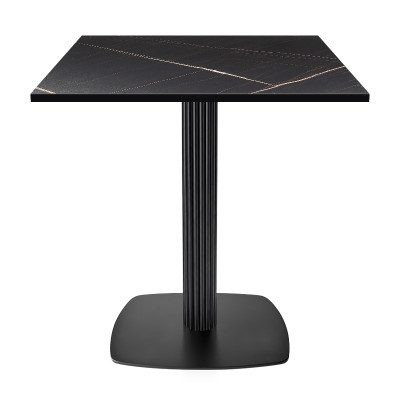
Home / All / OEM & Manufacturing / How to Pack Commercial Table Bases for Wholesale Shipping: Cartons or Pallets?
How to Pack Commercial Table Bases for Wholesale Shipping: Cartons or Pallets?
Oct 26,2026
For restaurants, hotels, cafes and commercial project buyers, commercial table bases usually go through long-distance ocean freight, container loading, stacking, repeated handling and final warehousing before they reach the end customer.
Packaging, therefore, is never just "putting the product into a carton".
For wholesalers, furniture distributors and project purchasers, a well-designed packaging solution needs to solve several problems at the same time:
How to prevent table bases from being scratched during transit?
How to reduce dents and deformation caused by impact?
How to keep metal surfaces away from moisture and rust?
How to improve container loading efficiency?
When should individual cartons be used?
When should export pallets be used?
Should FCL and LCL shipments be packed differently?
How to cut freight cost without sacrificing product safety?
For commercial table bases of different materials, sizes, structures and order quantities, there is no single packaging method that fits every order. The right solution is usually designed around product structure, order volume, freight mode, destination and the customer's warehousing conditions.
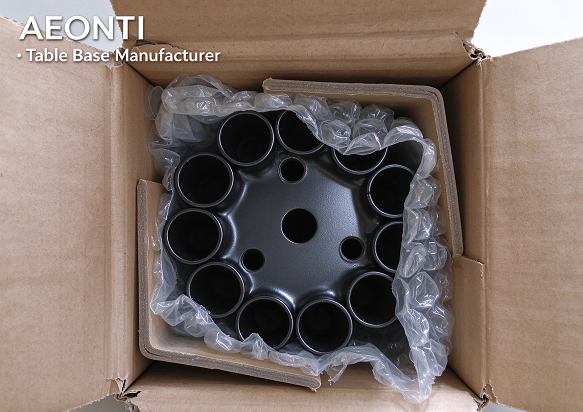
Packing structure of a commercial table base: product → protective foam → corner protector → export carton.
Commercial table bases are usually made of stainless steel, aluminum, iron or cast iron. Although metal table bases have good inherent strength, they are still vulnerable during long-distance transportation to impact, friction, compression, moisture and improper handling.
The most common problems include:
Scratched metal surfaces
Chipped powder coating
Scratches on stainless steel surfaces
Dents on table base edges and corners
Abrasion between products rubbing against each other
Rust caused by ocean-freight humidity
Carton deformation during stacking
Multiple handling cycles in LCL shipments
For wholesale orders, a large number of damaged products affects not just a single item but the delivery of an entire project. Packaging design is therefore part of commercial table base supply chain management.
What Commercial Table Base Packaging Must Achieve
Packaging Goal
Problem to Solve
Scratch prevention
Stop products from rubbing against each other or against the carton
Impact protection
Reduce shocks during loading, unloading and transit
Compression resistance
Prevent carton deformation under stacking
Moisture & rust protection
Lower oxidation risk in ocean-freight environments
Easy container loading
Improve container space utilization
Easy handling
Support forklift, manual and warehouse operations
Cost control
Protect products while keeping packaging volume reasonable
For B2B wholesale customers, good packaging is not "the thicker the better". It is a reasonable balance between protection, volume, weight and cost.
How Carton Packaging Protects Table Bases During Transit
For small and medium orders, mixed-SKU orders and many LCL shipments, export cartons are a very practical packaging method.
This structure minimizes product movement inside the box during transportation.
Individual Export Carton
Individual export cartons are a common way to pack commercial table bases. For stainless steel table bases, iron table bases and some aluminum table bases, 5-ply or reinforced corrugated cartons can be designed in different sizes according to the product dimensions.
For example:
1 table base + individual protective materials + custom carton
2–4 table bases of the same size + internal dividers + reinforced carton
The exact quantity depends on product weight and structure. The inside of a carton should never be simply "stuffed full" — the products must stay stable inside the box.
Foam & Corner Protector Prep
For table bases, edges and protruding parts are the areas most vulnerable to impact. Additional protection should be added at these positions:
EPE foam
EPE pearl-cotton rolls
Foam boards
Corner protectors
Bubble wrap
Table bases with base plates, mounting plates or special welded structures need extra protection at every protruding position.
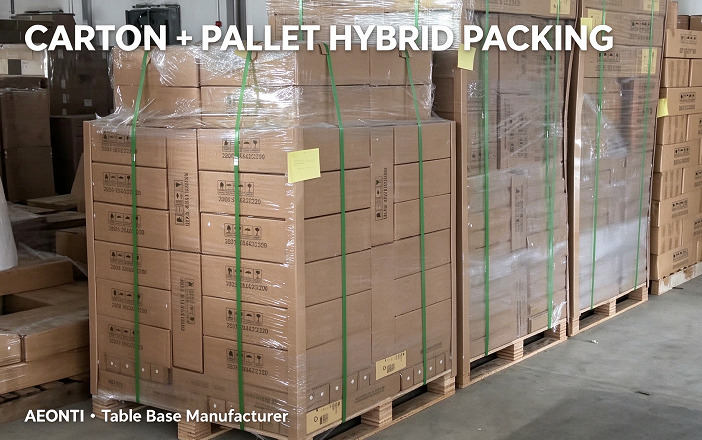
Hybrid Packaging: Cartons Stacked on Export Pallets (Industry Standard)
For bulk commercial table base orders, the hybrid "carton + export pallet" method is often more practical than cartons alone or pallets alone.
Why Hybrid Packaging Works Better for B2B Wholesale
First, cartons protect each individual product. Second, the pallet consolidates multiple cartons into one shipping unit. During loading and unloading, the whole pallet can be moved by forklift instead of handling cartons one by one.
Hybrid packing in the AEONTI factory: cartons of table bases stacked on an export pallet, fixed with stretch film and strapping.
Carton vs Pallet vs Hybrid: Cost, Protection & Loading Comparison
Each packaging method has its own advantages. B2B buyers can use the table below for a first-pass decision:
Method
Product Protection
Handling Efficiency
Space Utilization
Packing Cost
Best For
Cartons only
★★★
★★
★★★★
Low
Small orders / LCL
Pallets only
★★★★
★★★★★
★★★
Medium
Bulk orders
Carton + pallet
★★★★★
★★★★★
★★★
Medium–high
FCL / project orders
One caveat: pallets do not automatically mean lower freight cost. Pallets add packaging weight, packaging volume, occupied space and handling cost. The final solution should always be calculated from the actual product size and container loading plan.
One Important Principle
Do not simply chase "the strongest packaging". Chase "the most reasonable protection per unit of freight cost".
Critical Packaging Rules to Avoid Scratches, Dents and Rust
1. Products Must Never Rub Directly Against Each Other
This is especially critical for stainless steel, mirror-polished or electroplated surfaces. If two metal table bases keep rubbing against each other in transit, the result is scratches, abrasion and surface marks. Foam, pearl cotton or other divider materials must be used between products.
2. Protruding Parts Must Be Protected First
For example: base plates, mounting plates, screw holes, welding points and table base corners. These areas take impact far more easily than ordinary tube sections.
3. Take Moisture Protection Seriously
For ocean freight, the risk chain is: Moisture → Condensation → Rust. Depending on the material and transit time, consider:
Moisture-barrier bags
Plastic protective film
4. Cartons Are Not Only About Product Size
A carton must account for: product dimensions + protective material thickness + stacking strength + container loading method. An oversized carton increases shipping volume; an undersized carton lets the product touch the outer wall directly.
How to Select Packaging Based on Order Size & Freight Type
Different order sizes call for different packaging strategies:
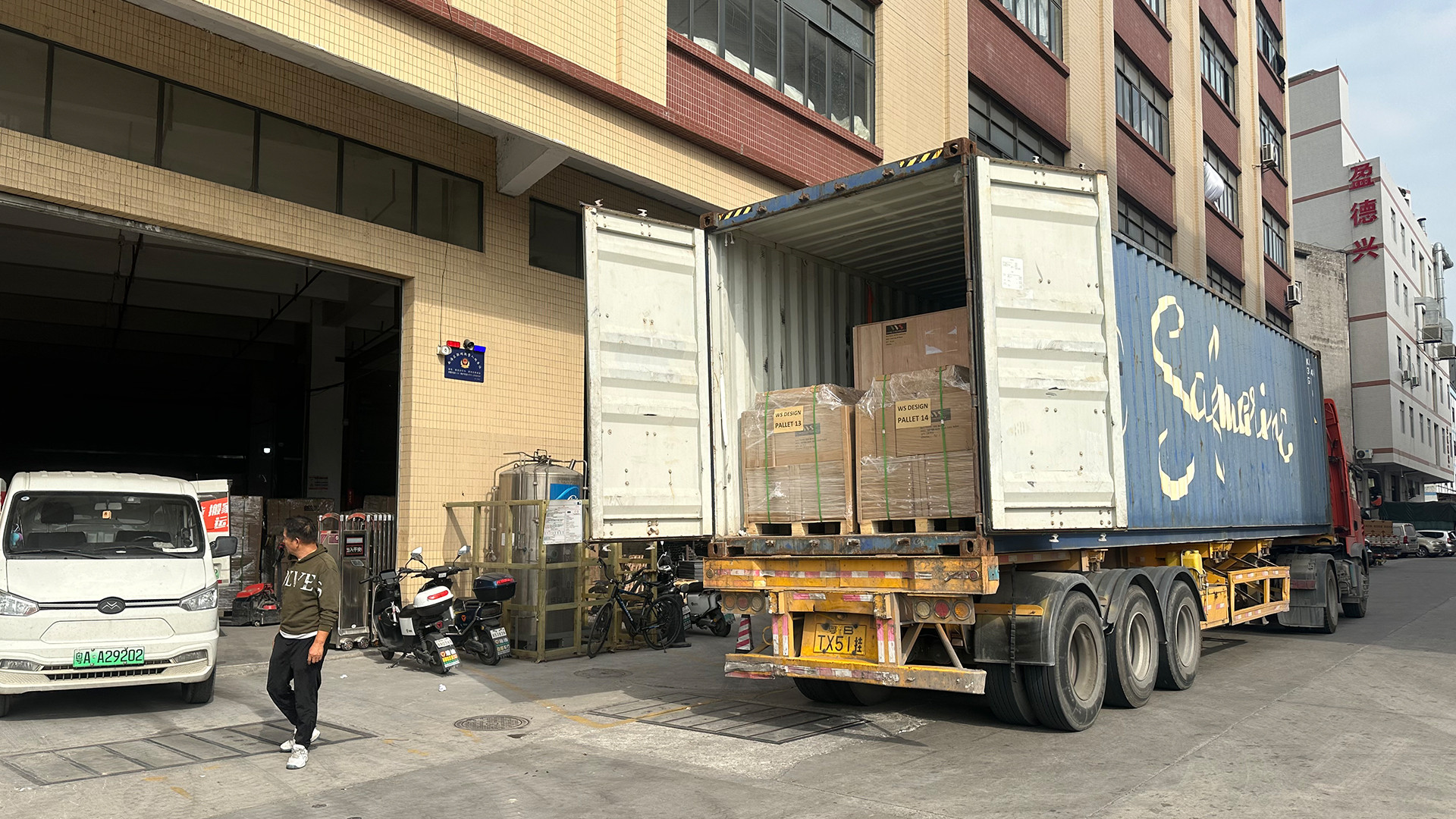
FCL (Full Container Load): the loading plan can be designed more freely, so carton + pallet with rational stacking works best to maximize container utilization.
LCL (Less than Container Load): goods go through more handling and transfer cycles, so outer-carton strength, internal fixing and impact protection matter even more.
Common Packaging & Shipping Mistakes for Metal Table Bases
Most transit damage is not caused by product quality issues but by poor packaging design. Frequent mistakes in commercial table base wholesale shipping include:
Mistake 1: Oversized cartons. Too much free space lets products move around in transit.
Mistake 2: Missing edge protection. The main body survives, but the base plate or mounting plate edges get deformed.
Mistake 3: Stacking different metal products directly on each other. Friction between products leaves surface scratches.
Mistake 4: Designing only for "it fits". Always ask: how will it be loaded? Packaging should be designed backwards from container loading and warehousing, not from whether the product fits into the carton.
Mistake 5: Looking only at packaging cost, not freight cost. Cheap packaging materials that increase product volume can raise the total logistics bill.
Packaging Checklist for FCL and LCL Table Base Shipments
Before shipping commercial table bases, run through this checklist:
Check Item
FCL
LCL
Individual product protection
✓
✓
Foam / corner protectors
✓
✓
Reinforced export cartons
✓
✓
Pallets
Recommended
Case by case
Stretch wrap
Recommended
Recommended
Strapping
Recommended
Recommended
Outer-carton labels
✓
✓
Container loading plan
✓
✓
Every link in the chain — Product → Packaging → Pallet → Container → Destination — needs to be considered before dispatch.
How Wholesalers Optimize Packaging to Cut Logistics Costs
For wholesalers, the real value of packaging optimization is not just cheaper packing materials. It is loading more products into every container. For the same 40HQ container, redesigning carton sizes, stacking patterns and pallet specifications can put more products into one shipment — which lowers the ocean freight cost per unit.
Both methods work for commercial table bases. Small orders can usually ship in reinforced cartons; bulk orders should consider hybrid carton + pallet packing. The final decision depends on product weight, size, order quantity and freight mode.
2. Are pallets necessary for FCL table base shipments?
Not always. If the cartons are strong enough and the loading plan is well designed, shipments can go without pallets. For heavier table bases or goods that need frequent forklift handling, pallets are usually more convenient.
3. Is pallet packaging better for LCL shipments?
Not necessarily. LCL involves more handling, so pallets improve overall stability — but they also add volume and weight. Calculate case by case.
4. How can I prevent stainless steel table bases from scratching?
For stainless steel table bases, use protective film, EPE foam, pearl cotton and corner protectors, and never let metal products touch each other directly.
5. How do you prevent metal table bases from rusting during ocean shipping?
Depending on material and transit time, use moisture-barrier packaging, anti-rust materials, desiccants or VCI anti-rust solutions.
6. Can table base packaging be customized?
Yes. Packaging for commercial table bases can be customized by product size, product weight, quantity, freight mode, destination and loading requirements.
7. What information should I provide for a custom packaging solution?
Provide: product model + quantity + product size + weight + shipping method + destination. The supplier can then design a more reasonable packing and loading plan.
Need a wholesale supplier who packs as well as they manufacture?AEONTI is a commercial table base manufacturer offering OEM/ODM service, custom packing solutions and FCL/LCL loading plans. Contact us for a quote →