How to Choose a Commercial Restaurant Dining‑Chair Manufacturer: A B2B Buyer's Guide
For restaurant operators, hotel purchasers and hospitality chain brands, dining chairs are not ordinary furniture. They are high‑wear‑and‑tear fixed assets that endure heavy daily use and directly shape guest experience and safety. A commercial chair has to withstand dozens of sitting loads, moves, bumps and sanitizing cleans every single day. Its annual wear far exceeds that of household furniture.
Yet many B2B buyers get off on the wrong foot: they compare styles and unit prices first, and only later check who manufactures the chairs and how they are made. Problems such as defective first shipments, missing spare parts and delivery delays arise once containers arrive at port. Buyers then find the savings from low unit prices cannot cover subsequent losses.
This guide walks you through six dimensions — materials, manufacturing capacity, quality‑control systems, customization capability, export experience and price structure — to evaluate whether a commercial dining‑chair manufacturer is worth long‑term cooperation. All assessment criteria are drawn from our hands‑on experience serving global hospitality clients and can be directly applied for supplier evaluation.
Commercial Dining Chairs vs Household Dining Chairs — They Are Fundamentally Different Products
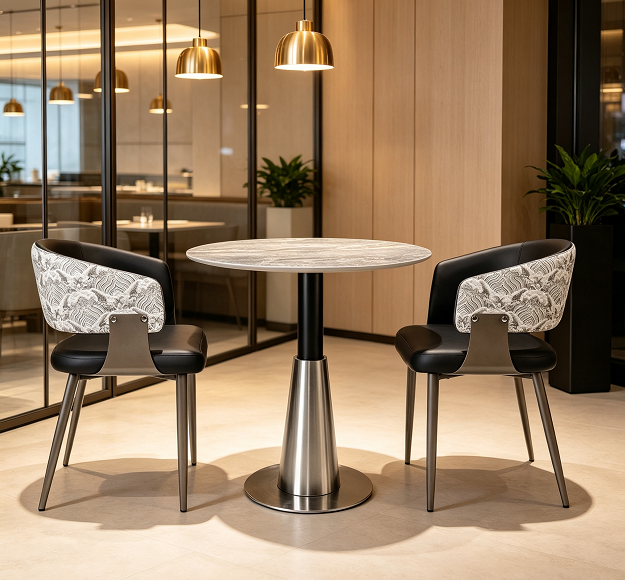
Commercial settings impose totally different requirements compared with home use. A household chair may be used a few hundred times per year, while a commercial chair can hit that volume in just one day. Distinguishing between these two product categories before purchase keeps you from buying commercial‑grade furniture based on household‑level budgets and standards.
| Evaluation Item | Commercial Dining Chair | Household Dining Chair |
| Usage Intensity | Dozens of sits, moves and stacking cycles daily for years | Gentle use, several times per day |
| Load‑bearing Requirement | Structural components must pass repeated impact and fatigue tests | General load‑bearing capacity suffices |
| Cleaning & Sanitization | Frequent wiping and sanitizing; surface must resist chemicals | Routine cleaning only |
Safety Standards | Must meet local commercial‑furniture safety requirements for hospitality venues | Household safety standards |
Procurement Method | B2B bulk purchase; focus on MOQ, lead time and packaging | Single‑unit or small‑quantity purchase |
Decision‑making Factors | Total cost of ownership, durability, repairability, supplier stability | Appearance, price |
Key advice for buyers: For commercial procurement, the formula is not “lowest unit price”.
Total Cost of Ownership = Purchase Price + Replacement Frequency + Business‑disruption Risk
A cheap chair that breaks in half a year costs far more than one priced 20 % higher that lasts a decade.
Understand Materials First, Then Make Selections
Around 80 % of a dining chair’s durability, texture and cost are determined by materials. You do not need to be a material expert as a buyer, yet you must understand supplier descriptions and judge workmanship quality. Below is a comparison of common frame materials for commercial metal dining chairs — questions we receive most frequently in production.
Chair Frame Material Comparison
| Material | Key Features | Application Scenarios | Points for Procurement Check |
| Corrosion‑resistant, rust‑proof, easy to clean; supports brushed, mirror or coated finishes | Humid environments, seaside restaurants, venues requiring frequent sanitization | Confirm material grade (e.g. 201 / 304) and surface‑treatment workmanship | |
| Lightweight, rust‑free, supports various anodized colors | Settings requiring frequent moving and stacking; lightweight‑focused projects | Check wall thickness and structural strength to avoid deformation from overly thin material | |
| Heavy, stable, impact‑resistant; classic aesthetic | Traditional‑style restaurants, bar stools, projects requiring solid visual weight | Check anti‑rust treatment and polishing workmanship | |
Cost‑effective, fast forming, suitable for mass production | Economy chain restaurants, fast‑food outlets | Check sheet thickness and welding‑joint strength | |
High strength, good malleability; most widely used with powder‑coating finish | Most commercial hospitality scenarios | Check pipe wall thickness, welding workmanship and coating adhesion |
Industry insight: Steel‑pipe frames with powder coating are the most widely‑adopted solution for commercial metal dining chairs. They deliver good cost‑performance, abundant color options and scratch resistance. For high‑end or humid environments, prioritize 304 stainless steel. Pick aluminum alloy when light weight is needed. Material alone is not the deciding factor; structure and workmanship must match your usage scenario.
Seat & Backrest Materials
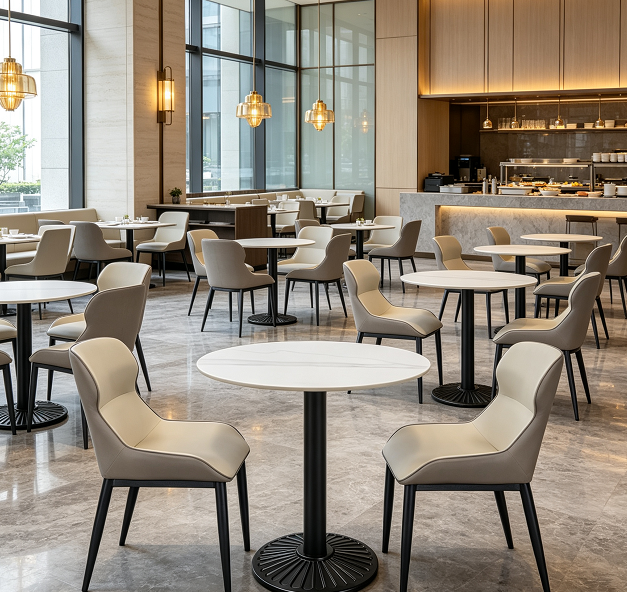
Besides chair frames, seat and backrest materials also affect comfort and service life.| Seat Material | Advantages | Considerations |
| Upholstery (Fabric / PU / Genuine Leather) | High comfort, upgraded premium look | For commercial use, select wear‑resistant and detachable‑washable fabrics |
| Plastic / Injection‑molded Plastic | Easy to clean, vibrant colors, low cost | Verify material toughness to prevent cold‑temperature brittleness |
How to Verify a Manufacturer’s Real‑world Capabilities
With material knowledge covered, we move to the core part: judging whether a factory is competent. Verify the six dimensions below; request real‑shot photos, samples or arrange factory audits whenever possible.
1. Manufacturing Workmanship
Welding: Check for full, uniform welds with no blowholes or cold solder joints these determine frame strength.
Surface Treatment: Confirm rust removal and pre‑treatment before powder coating or electroplating, which directly define coating adhesion and anti‑rust service life.
Forming Equipment: Check whether the factory owns in‑house equipment such as laser cutters.
2. Production Capacity & Order Lead‑time Matching
| Check Item | Questions to Ask |
| Monthly Capacity | Monthly output for standard models and customized models respectively |
| Lead Time | Lead‑time for samples, mass production and repeat orders |
| Peak‑season Arrangement | Whether your procurement peak overlaps with the factory’s capacity bottlenecks |
3. Systematic Quality Inspection
Qualified commercial furniture manufacturers implement full‑process inspection from incoming raw‑material check to finished‑goods outbound control: incoming‑material inspection, welding‑strength sampling test, full surface‑quality inspection, pre‑shipment sampling inspection.
During procurement, confirm consistency between sample quality and mass‑production goods, plus traceable inspection records for bulk orders.
Chain restaurants often need brand‑specific colors, custom dimensions or logo marking. When evaluating manufacturers, confirm availability of custom colors, dimension adjustments, logo screen‑printing / embossing, and full OEM / ODM services.
5. Rich Export Experience
Export is far more than simply dispatching goods. An experienced manufacturer understands export‑grade packaging (moisture‑proof, scratch‑resistant, stacking‑ready), provides complete export documents (packing list, commercial invoice, certificate of origin etc.), complies with quality and compliance standards for target markets, and knows how to resolve issues when they emerge.
Quality Inspection & Export Packaging — The Final Two Safeguards for Arrival Quality
Many procurement failures happen not during production, but during transit. From Chinese factories to overseas restaurants, commercial chairs go through container loading, ocean freight, customs clearance and inland transport.
Common Inspection Items for Commercial Chairs
| Inspection Item | Inspection Purpose |
| Coating Adhesion Test | Confirm scratch resistance and anti‑peeling performance of surface coating |
Assembly & Hardware Check | Verify tightness of screws, floor glides and connecting fittings |
| Full Finished‑goods Visual Check | Rule out scratches, color deviation and welding defects |
Export Packaging Key Points
- Individual‑unit protection: Wrap every chair with EPE foam; reinforce high‑stress contact points.
- Multi‑layer protection: Use 5‑ply or higher‑strength cartons with reinforced sealing.
- Pallet loading: Palletize finished cartons and stretch‑wrap for forklift handling and moisture resistance.
- Container‑loading planning: Optimize loading layout by container type to maximize container fill rate while avoiding compression‑caused deformation.
- Markings & Documents: Clear shipping marks, complete packing lists, commercial invoices and other export paperwork.
Procurement tip: For first‑time cooperation, ask for packaging solutions and container‑loading diagrams. Request pre‑shipment photos before bulk‑goods dispatch. These details best reflect a factory’s professionalism.
Price & MOQ — Calculate Total Cost, Do Not Only Compare Unit Prices
A frequent pitfall in commercial procurement is comparing quotations purely by unit price. With equivalent quality, price gaps mainly stem from factors listed below. Cross‑check each item to calculate your total cost.
| Price‑influencing Factor | Explanation |
| Material & Specification | Material choice between stainless steel and iron pipe; pipe / sheet thickness directly drives cost |
| Surface Treatment | Cost differences brought by coating color quantity, electroplating or antiquing finishes |
| Customization Level | Standard models cost least; custom colors, dimensions or logos add production steps |
Order Volume & MOQ | Larger volumes lower unit cost; lower MOQ indicates better supplier flexibility |
Packaging Method | Individually packed vs bulk packing; palletization requirement |
Trade Term | Prices vary under FOB / EXW; make sure you compare quotations under identical trade terms |
Reference for payment terms: Common international‑trade payment methods include T/T (Telegraphic Transfer), normally a deposit percentage plus balance before shipment. Clarify payment milestones, delivery timelines and delay liabilities in contracts.
Why Choose AEONTI
AEONTI is a manufacturer specializing in table base, table tops and complete dining‑table‑and‑chair sets. With years of industry experience and solid export track record, we serve restaurant, hotel and furniture buyers globally.
Our core strengths:
- Full‑range metal chair frames: stainless steel, aluminum alloy, cast iron, stamped iron and iron, covering commercial dining‑chair requirements across price tiers and styles.
- Matching multi‑material table tops: sintered stone, artificial marble, wood‑based panels and HPL. Matching tables and chairs deliver unified styling and streamlined procurement.
- Complete‑set solution: supply standalone dining chairs as well as full table‑and‑chair packages; support single‑item orders and whole‑venue fit‑out projects.
- Long‑standing export expertise: proficient in export packaging, documentation and logistics; full traceability from sample development to full‑container delivery.
- Customization services: custom colors, dimensions and logo marking to satisfy unified brand‑image requirements for chain brands.
Why buyers maintain long‑term cooperation with us?
We embed “commercial‑grade standards” into every production step: welding strength, coating adhesion and packaging protection are all executed for heavy‑duty commercial scenarios. For buyers, stable quality and reliable lead times are more valuable than one‑off lowest prices.
Final Decision Checklist (Print for Practical Use)
Check each item before placing orders with suppliers:
| No. | Check Item | Satisfied? |
| 1 | Clarify usage scenario (restaurant type, usage frequency, ambient humidity) | ☐ |
| 2 | Confirm materials and specifications (chair‑frame material, seat‑surface material) | ☐ |
| 3 | Request sample chairs for real‑world testing (stability, comfort, workmanship details) | ☐ |
4 | Verify manufacturing workmanship (welding, surface treatment, pre‑treatment procedures) | ☐ |
5 | Confirm quality‑control workflow and inspection standards | ☐ |
6 | Clarify customization requirements (color, dimension, logo) and relevant costs | ☐ |
7 | Confirm MOQ, lead time and production scheduling plan | ☐ |
8 | Confirm packaging solution and container‑loading plan | ☐ |
9 | Unify trade terms and payment conditions; clarify liabilities for delivery delays | ☐ |
Frequently Asked Questions (FAQ)
Q1: What is the biggest difference between commercial dining chairs and household dining chairs?
The core gap lies in usage intensity and standards. Commercial chairs endure dozens of sits, moves and sanitizing cycles each day, hence higher requirements for structural strength, surface wear‑resistance and stability.
Q2: Which metal dining‑chair frame material is the most durable?
It depends on usage scenarios. Pick 304 stainless steel for humid environments; opt for powder‑coated iron pipe for cost‑performance and rich color choices; cast iron for heavy‑weight stability; aluminum alloy when light weight is needed. No material is universally superior; matching material to scenario is critical.
Q3: What is the typical MOQ for custom dining chairs?
MOQ varies per model and customization scope. Color customization and dimension customization normally carry different minimum‑order thresholds. Discuss specific models directly with your manufacturer for exact custom solutions and MOQ.
Q4: How can I assess a factory’s export competence?
Check for mature export‑grade packaging solutions, complete export documentation capability, familiarity with destination‑port logistics, provision of container‑loading plans and pre‑shipment photos, plus track‑record of past export markets.
Q5: What is the typical timeline from order placement to goods receipt?
Lead times for sample production, mass manufacturing and ocean freight differ, determined by model (standard vs customized), order quantity and destination port. Confirm full timelines with your manufacturer and build in buffers before procurement.
Closing Remarks
Selecting a commercial dining‑chair manufacturer means choosing a long‑term supply‑chain partner. Material‑scenario matching, solid workmanship, systematic QC and smooth export procedures all deserve careful validation before placing orders.
If you are sourcing dining chairs, tables or table tops for restaurants, hotels or chain brands, feel free to contact AEONTI. We can provide samples, factory information and professional advice, helping you maximize value from every procurement dollar.