Commercial Table Bases for Small-Space Dining: How Base Design Affects Seating Capacity
For restaurants, cafes, bars and hotel dining spaces, space utilization directly affects operating efficiency.
For small restaurants with limited floor area in particular, adding one more table does not necessarily mean adding more seats.
If the table base position and design are not well considered, you may run into:
- Chairs that cannot be fully pushed under the table
- Insufficient legroom for customers
- Two chairs that cannot sit side by side
- Larger required distances between tables
- Wall-side seating that cannot be used properly
- Table base and chair legs colliding with each other
- A 4-person table that comfortably seats only 3 people
Therefore, in commercial dining projects, the design of a table base does not only determine the stability of the table — it also directly affects the space under the table, chair placement and the final Seating Capacity.
For restaurant furniture wholesalers, distributors and project buyers, choosing a table base should not only be about:
"Can this table base support the tabletop?"
But also:
"Will this table base take up the customer's leg space?"
Why Table Base Design Matters for Restaurant Seating Capacity
Many restaurant buyers start their table planning with:
Tabletop Size → Table Shape → Number of Seats
and only then choose the table base.
In reality, however, the table base also works backwards and shapes the seating layout.
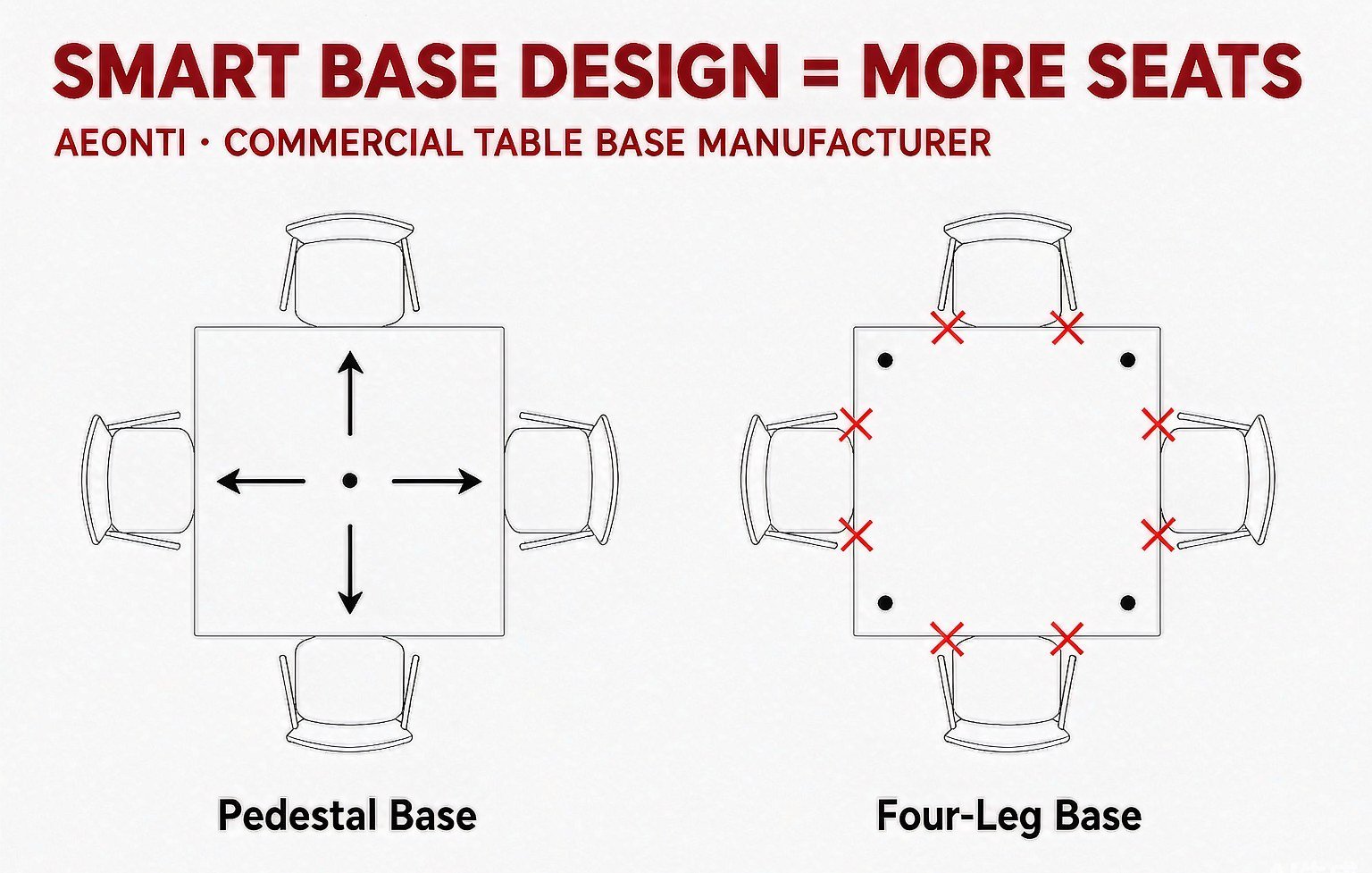
For example, with a 700 × 700 mm square table, if a central Pedestal Base is used, customers can sit down freely from all four sides.
But if four independent legs are used and some of them sit near the tabletop edge, they may conflict with the chairs.
Therefore:
Table Size ≠ Actual Seating Capacity
A more accurate relationship is:
Tabletop Size + Table Base Design + Legroom + Chair Position = Usable Seating Capacity
A Simple Example
Assume two tables have exactly the same tabletop size:
| Item | Table A | Table B |
|---|
| Tabletop size | 700 × 700 mm | 700 × 700 mm |
| Table base | Central Pedestal | Four-Leg Base |
| Chair space | Wide | Affected by legs |
| Legroom | Good | Possibly limited |
| Chair positioning | Flexible | Many fixed positions |
| Small-space suitability | ★★★★★ | ★★★ |
In small restaurants, the structure of the table base sometimes deserves more attention than the tabletop size itself.
How Table Base Designs Reduce or Increase Legroom
Different base structures produce completely different legroom. Below are the most common base designs in commercial dining tables.
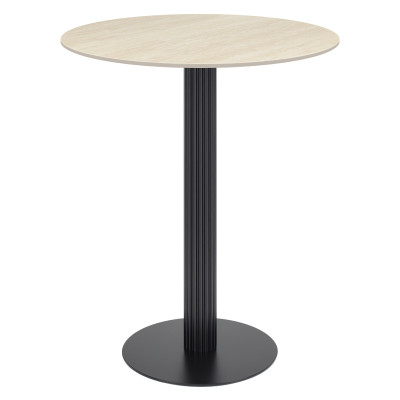
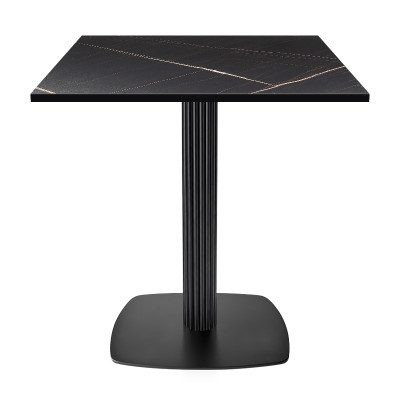
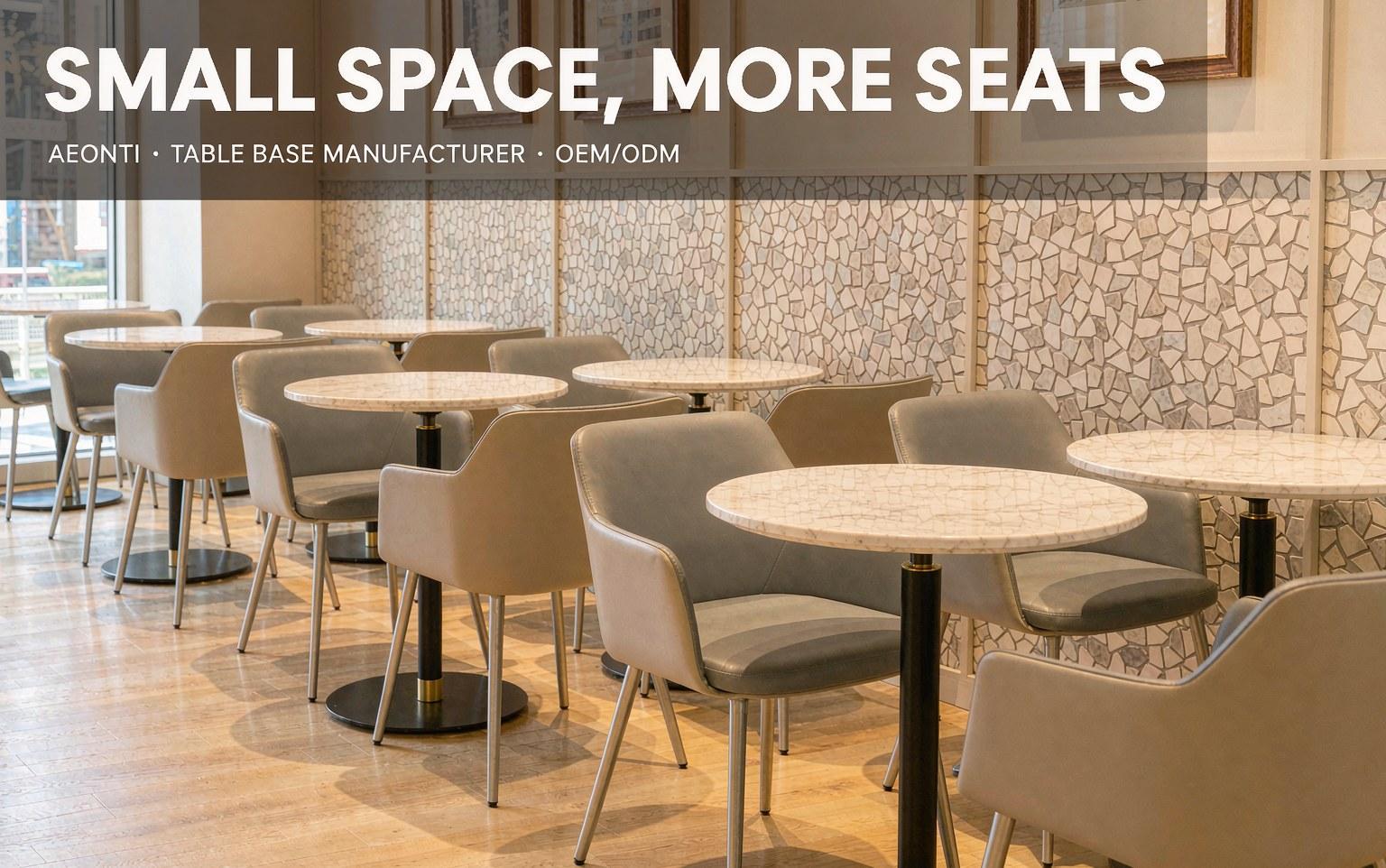
A Pedestal Base (single-column / central base) concentrates the main support structure in the center of the table.
Its biggest advantage:
It releases as much space as possible around the tabletop.
It is well suited to:
- Small restaurants
- Cafes
- Bistros
- Commercial dining spaces
- Small square tables
- Round tables
Especially for 4-person tables, a central base allows customers to adjust their chairs much more freely.
Advantages
- Freer legroom
- More flexible chair positions
- Suitable for small spaces
- No obvious obstacles around the tabletop
- Easy floor cleaning
What to watch
A Pedestal Base needs a base plate size matched to the tabletop. If the base plate is too large, it can also affect the customer's foot space.
The Four-Leg Base is the traditional four-leg table structure.
Its strengths:
- Straightforward structure
- Good stability
- Mature manufacturing
- Compatible with many tabletops
But its biggest drawback is also obvious:
The leg positions are relatively fixed.
If a leg happens to sit in the chair zone, it affects the customer's legroom.
Therefore, a Four-Leg Base is more suitable for:
- Larger dining tables
- Projects with high furniture style requirements
- Commercial spaces that need specific table base styling
A T-Base concentrates the support structure on two sides of the tabletop or in the middle of the frame.
Its characteristics: it balances stability and legroom.
It is especially useful for rectangular tabletops, for example:
- 1200 × 600 mm
- 1400 × 700 mm
A T-Base reduces obstruction in the middle of the table and gives customers better legroom.
A Cross Base concentrates the support structure in the center of the table.
It usually suits:
The biggest advantage of a Cross Base:
Customers can sit on all four sides.
But pay attention to the lateral size of the base — if the base is too large, it can take up the customer's foot space instead.
A Double Base is typically used for longer tabletops, such as 1600 mm, 1800 mm, 2000 mm or even longer dining tables.
Compared with a single central base, a Double Base provides better structural stability.
At the same time, it controls legroom more easily than a traditional four-leg structure.
Especially suitable for:
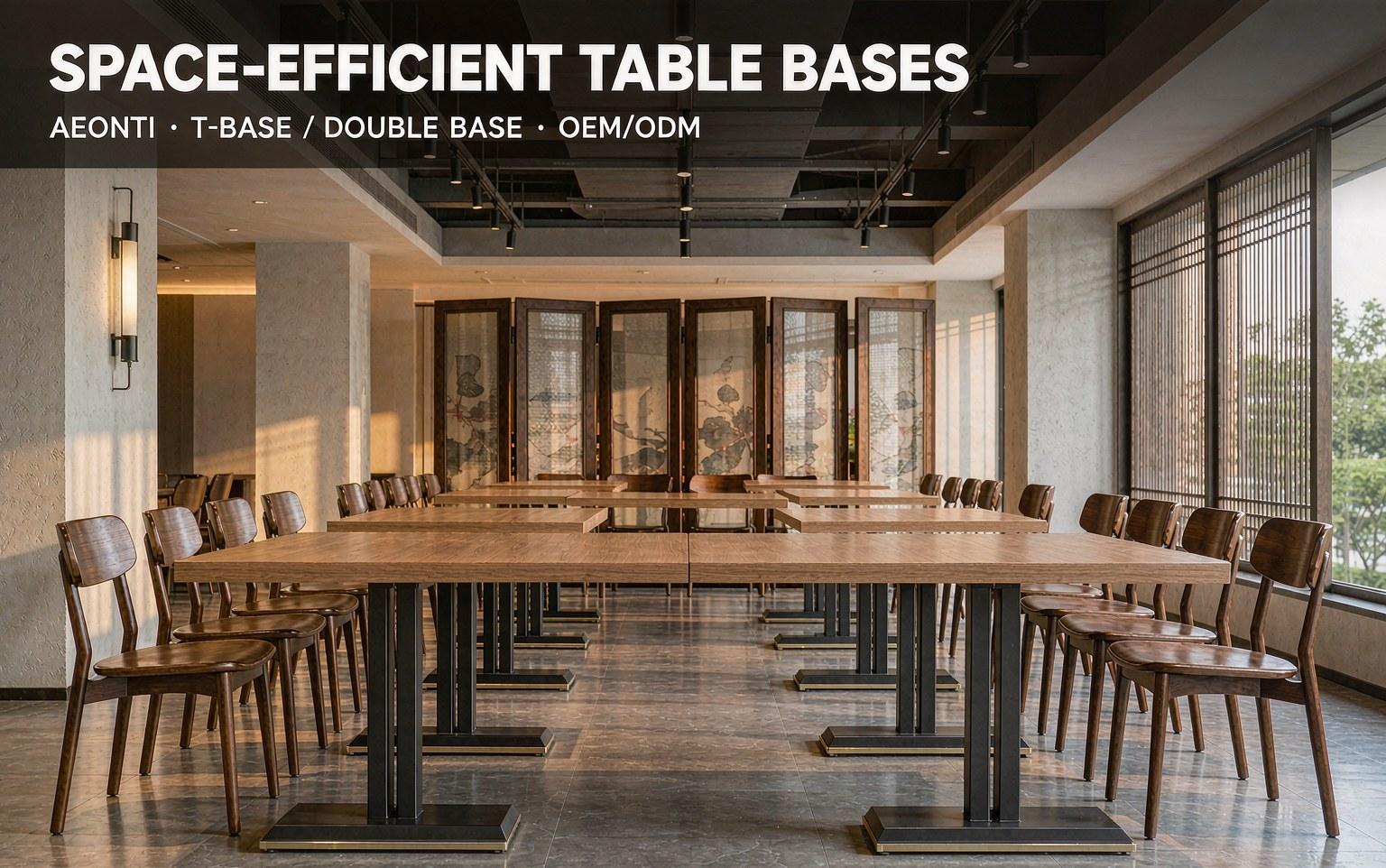
Table Base vs Legroom: What Buyers Should Consider
When sourcing commercial table bases, do not focus only on Load Capacity. Consider at the same time:
Legroom + Chair Position + Tabletop Size
Here is a quick selection reference:
Please note: this is not an absolute ranking. The final choice also depends on tabletop size, weight, base dimensions, tabletop material and the actual usage scenario.
How to Choose Table Bases for Small Restaurants
For small restaurants, table base selection should revolve around one core goal:
Maximize Seating Without Sacrificing Comfort
In other words: add seats within limited space while keeping reasonable customer comfort.
Buyers are advised to focus on the following 5 factors.
1. Tabletop Size
Common small tabletop sizes include:
- 600 × 600 mm
- 700 × 700 mm
- 800 × 800 mm
- 800 × 600 mm
The smaller the tabletop, the more important the table base position becomes.
2. Base Footprint
The larger the base plate, the more floor space it usually occupies. So you need to find the balance between:
Stability + Footprint
3. Chair Position
The table base must not prevent chairs from being pushed under the table. Especially in restaurants with high seat turnover, whether chairs can move smoothly is critical.
4. Tabletop Material
Different tabletop materials have very different weights. For example, solid wood, sintered stone and artificial marble table tops can differ significantly in weight.
Therefore the load capacity of the table base must match the tabletop.
5. Restaurant Layout
The same table base can perform completely differently in different restaurant layouts. For example, wall-side tables and free-standing central tables may need different base designs.
Best Table Base Configurations for 2-, 4- and 6-Person Tables
The following can serve as a basic reference for restaurant project purchasing:
| Seating | Typical Table Size | Recommended Base | Recommended Application |
|---|
| 2 Person | 600 × 600 mm | Pedestal / Cross Base | Café / Bistro |
| 2 Person | 700 × 600 mm | Pedestal / T-Base | Small Restaurant |
| 4 Person | 700 × 700 mm | Pedestal / Cross Base | Restaurant |
| 4 Person | 800 × 800 mm | Pedestal / Cross Base | Café / Hotel |
| 4 Person | 1200 × 700 mm | T-Base | Restaurant |
| 6 Person | 1200 × 800 mm | Double Base | Restaurant |
| 6 Person | 1400 × 800 mm | Double Base | Hotel / Restaurant |
| 6+ Person | 1600+ mm | Double Base | Commercial Project |
The actual number of seats still needs to be confirmed against local dining space regulations, chair dimensions, table spacing and aisle requirements.
How Base Placement Affects Chair Positioning
The position of the table base directly affects chair positions — a detail that is easily overlooked at the design stage of commercial projects.
Central Base
With a central base:
Chair → Open Space → Base ← Open Space → Chair
The space on all sides is freer.
Corner Legs
With four corner legs:
Chair → Leg → Limited Space
If the legs overlap with chair positions, customers have to keep adjusting their posture.
Double Base
For long tables, two bases should be positioned according to:
Table Length + Chair Position + Load Distribution
They should not simply be placed at equal distances.
Common Table Base Layout Mistakes in Commercial Projects
Mistake 1: Choosing a table base only by tabletop size
The same tabletop size does not mean every table base will work.
Mistake 2: Ignoring chair width
For example, a tabletop of 700 mm does not automatically fit two chairs. You also need to consider:
Chair Width + Armrest + Base Position
Mistake 3: Oversized base plate
Many people assume: Bigger Base = More Stable. In reality an oversized base can cause:
More Stability → Less Legroom
Balance is required.
Mistake 4: Ignoring tabletop weight
Especially with sintered stone, porcelain and heavy wood table tops. The table base must account not only for size but also for:
Load Capacity + Tabletop Weight
Mistake 5: Using the same table base for every table
This is a very common problem in commercial dining projects. A 2-person table and a 6-person table usually should not share exactly the same base design.
How Wholesalers Can Build a Space-Efficient Table Collection
If you are a restaurant furniture wholesaler, instead of sourcing many completely different table base models, consider building a Space-Efficient Table Collection, for example:
Collection A — Small Café Tables
- 600 × 600 mm
- Pedestal Base
- Cross Base
- Suitable for: Café / Bistro / Small Restaurant
Collection B — Standard 4-Person Tables
- 700 × 700 mm / 800 × 800 mm
- Pedestal Base
- Cross Base
- Four-Leg Base
Collection C — Rectangular Restaurant Tables
- 1200 × 700 mm
- T-Base
- Double Base
Collection D — Large Commercial Tables
This way a wholesaler can form a clear product matrix:
| Collection | Table Size | Seating | Base Options | Main Market |
|---|
| Café | 600 × 600 | 2 | Pedestal / Cross | Café |
| Compact Dining | 700 × 700 | 2–4 | Pedestal / Cross | Restaurant |
| Standard Dining | 800 × 800 | 4 | Pedestal / Four-Leg | Restaurant |
| Rectangular | 1200 × 700 | 4 | T-Base / Double | Restaurant |
| Large Dining | 1400–1800+ | 6+ | Double Base | Hotel / Project |
This makes selection easier for customers — and SKU management easier for wholesalers. Matching table tops and complete tables can be added to each collection as one-stop options.
FAQ
1. Which table base provides the most legroom?
Generally, a central Pedestal Base and a Cross Base provide the freest legroom. The actual effect still depends on base size and tabletop size.
2. Are pedestal bases better for small restaurants?
Usually yes. A central base reduces structural interference near the table edge and makes chairs easier to adjust.
3. Are four-leg table bases good for restaurants?
Yes. A Four-Leg Base is stable and mature in production, but check whether the legs affect chairs and customer legroom.
4. What table base is best for a 4-person restaurant table?
For a 4-person table around 700 × 700 mm or 800 × 800 mm, consider a Pedestal Base, Cross Base or Four-Leg Base, depending on tabletop weight and design style.
5. What table base is best for long restaurant tables?
For tables longer than 1200 mm, consider a T-Base or Double Base — usually easier to balance stability and legroom.
6. Can the same table base be used for different tabletop sizes?
Yes, but confirm: Load Capacity, Base Footprint, Tabletop Size, Tabletop Weight and Stability. Never judge by appearance alone.
7. Can table bases be customized for restaurant projects?
Yes. Commercial projects can usually be customized in: Tabletop Size, Tabletop Material, Table Height, Base Size, Tube Size, Finish and Top Plate.
Request a Free Commercial Table Base Recommendation from AEONTI
For small-space dining, choosing the right commercial table base is never just about "a base that can support the tabletop".
What really needs to be considered is:
Table Size + Seating Capacity + Legroom + Chair Position + Stability
If you are sourcing table bases for a restaurant, cafe, hotel or commercial project, send the following details to AEONTI and our engineering team will get back to you within 24 hours:
- Tabletop Size & Material
- Number of Seats / Seats per Table
- Table Height
- Estimated Quantity
- Project Type (Restaurant / Café / Hotel / Chain)
- Shipping Destination (FCL or LCL)
Based on your tabletop dimensions, usage scenario and seating targets, AEONTI will recommend the most suitable configuration from:
What you get with every inquiry:
- Free base recommendation matched to your tabletop and seating layout
- Load-capacity check for heavy sintered stone and solid wood table tops
- Sample support and OEM/ODM customization (size, tube, finish, top plate, logo)
- Packing and container-loading plan to maximize every shipment
- One-stop matching with table tops and complete tables
Send your inquiry to AEONTI today — get a commercial table base solution that keeps your tables stable and your seating capacity and legroom fully optimized in limited space.