Beginner's Guide: How to Find a Reliable Table Base Manufacturer in China
Whether you are sourcing dining table bases in bulk for restaurants or looking for customized hospitality table bases for a hotel project, first-time buyers working with Chinese table base factories can easily feel overwhelmed by the amount of information available.
This guide takes you step by step through the entire sourcing process—from identifying and evaluating reliable manufacturers to sampling, quality inspection, and final shipment.
Why Choose a Table Base Manufacturer in China?
China holds a leading and irreplaceable position in the global furniture hardware supply chain, especially in the table base manufacturing industry.
The reason is not simply "lower prices." China's real advantage comes from its complete and highly integrated manufacturing ecosystem.
Six Major Advantages of China's Table Base Manufacturing Industry
| Advantage | Description |
| Industrial Cluster Effect | Effect Furniture hardware clusters in Foshan, Guangdong; Shengfang, Hebei; and Anji, Zhejiang bring together thousands of table base factories. Raw material suppliers, surface treatment providers, and mold developers are often located within a 50-kilometer radius, significantly reducing logistics costs. |
| Complete Manufacturing Capabilities | Manufacturing Capabilities Chinese manufacturers cover almost every process required for table base production, including metal cutting, welding, tube bending, die casting, CNC machining, powder coating, electroplating, and brushing. |
| Flexible Production Capacity | Whether you are a small wholesaler looking for 200 sets of OEM table bases or a commercial project contractor purchasing 100,000 sets annually, you can find a factory with production capacity that matches your needs. |
Wide Range of Materials | Flat iron plates, aluminum, stainless steel, cast iron, and iron stamping bases are all widely available. In major manufacturing hubs such as Foshan and Shengfang, buyers can typically find multiple specialized factories for each material category. |
Cost Advantages | Thanks to competitive raw material prices, labor costs, and mold cost allocation, the overall landed cost of Chinese manufacturing is often 40%–60% lower than in Europe and North America and 15%–25% lower than in Southeast Asia. |
Fast Response and Short Lead Times | Mature sampling systems can typically turn drawings into physical prototypes within 7–15 days, while bulk production lead times are commonly around 25–45 days. |
Table Base Manufacturers by Material
Different materials require different manufacturing processes, equipment, and quality control standards.
Choosing the right manufacturer therefore depends heavily on the material and application of your table base.
Aluminum Table Base Manufacturers
Aluminum table bases are valued for their lightweight construction, corrosion resistance, and refined appearance. They are widely used in high-end restaurants, hotel lobbies, outdoor furniture, and commercial hospitality projects.
| Item | Details |
| Common Materials | die-cast aluminum, extruded aluminum profiles, aluminum sheets |
| Forming Processes | Die casting, aluminum extrusion + CNC machining, aluminum sheet bending |
| Surface Finishes | Anodizing, powder coating, brushing, polishing |
Typical Products | High-end hotel table bases, conference table bases, outdoor aluminum table frames |
MOQ | Typically 100 pieces for die-cast parts; 300 sets for extruded aluminum products |
Price Range | $30–$150 per set |
Major Manufacturing Locations | Foshan, Guangdong; Ningbo, Zhejiang |
Beginner's Tip:
When sourcing die-cast aluminum table bases, pay close attention to potential porosity defects. For extruded aluminum products, check for color consistency in anodized finishes. It is recommended to clearly define acceptable color variation tolerances in the purchase contract.
Stainless Steel Table Base Manufacturers
Stainless steel table bases combine high strength with excellent corrosion resistance. Their premium metallic appearance makes them a popular choice for commercial restaurants, hospitality projects, and high-end residential furniture.
| Item | Details |
| Common Materials | 201 stainless steel for economical applications; 304 stainless steel for food-contact and higher-end applications |
| Forming Processes | Laser cutting, bending, polishing |
Surface Finishes | Brushed, polished, sandblasted, PVD color coating such as rose gold and black titanium |
Typical Products | Restaurant table bases, bar table bases, high-end residential dining table bases |
MOQ | Typically 50–200 sets per model |
Price Range | $20–$150 per set |
Major Manufacturing Locations | Foshan, Guangdong; Jiangmen, Guangdong |
Beginner's Tip:
Cases of 201 stainless steel being misrepresented as 304 stainless steel do occur in the market. Your purchase contract should clearly specify "304 Stainless Steel (SUS304)". During inspection, consider using a stainless steel testing solution or other professional material verification methods to confirm the material grade.
Aluminum vs. Stainless Steel Table Bases: A Comparison
| Comparison Factor | Aluminum Table Bases | Stainless Steel Table Bases |
| Strength | ★★★☆☆ | ★★★★☆ |
| Weight | Lightweight | Medium |
| Corrosion Resistance | ★★★★☆ | ★★★★★ |
Surface Appearance | Fine and premium | Premium brushed metal appearance |
Cost Level | Higher | Medium |
Best Applications | High-end hotels, outdoor furniture | Restaurants, hospitality venues, luxury homes |
MOQ Flexibility | Higher barriers for die-cast products | More flexible |
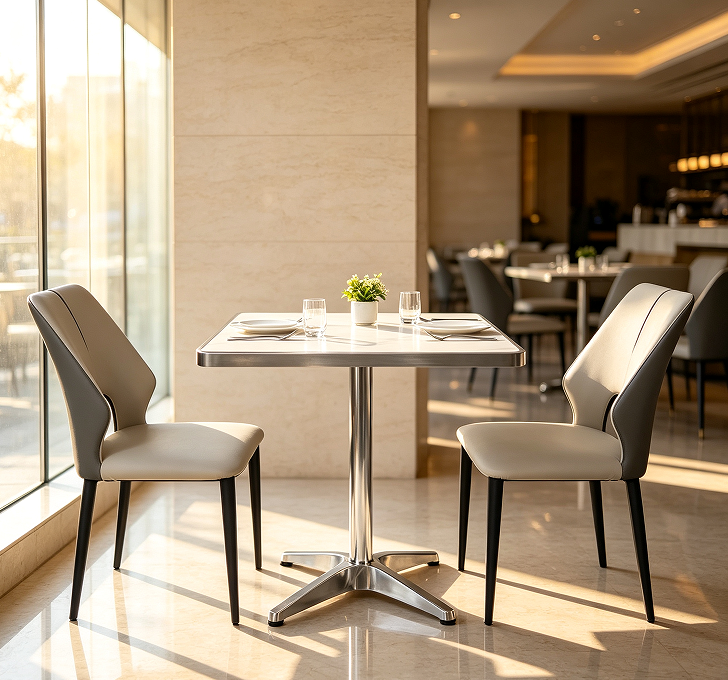

Key Takeaway:
Aluminum is a strong choice when weight reduction and corrosion resistance are priorities, while stainless steel is often preferred when strength, durability, and a premium appearance are more important.
How to Evaluate a Reliable Table Base Manufacturer: Qualifications, Capacity, and Customer Experience
Finding a reliable table base manufacturer is not a matter of luck. It requires a repeatable and systematic evaluation process.
Manufacturer Evaluation Checklist
| Evaluation Area | Key Indicators | How to Verify |
| Business Qualifications | Business license, international certifications | Request scanned copies and verify the company's operating status through official or trusted business registration databases |
| Production Capacity | Factory size, number of production lines, monthly capacity | Conduct a video factory audit and verify the equipment list, especially welding machines and powder coating lines |
| R&D Capabilities | Engineering team size, mold development lead time | Send a test drawing and evaluate the manufacturer's response speed, technical feedback, and proposed solution |
Customer Experience | Previous brands, annual export volume, key export markets | Request recent packing photos and customer references. Confirm the manufacturer can produce products compliant with your target market's requirements |
Quality Control System | IQC, IPQC, OQC | Ask whether the factory has a dedicated QC team and whether factory inspection reports are available |
Communication | English proficiency, response time, problem-solving attitude | Use the initial communication process as a test. Ask technical questions and evaluate whether the answers are professional and complete |
Core Principle
Don't just look at the showroom samples. Always inspect the production line.
A beautiful showroom does not necessarily mean the factory has strong production capabilities. Whenever possible, conduct a factory audit—either in person or through a detailed video inspection.
Table Base Factory Sampling Process: From Drawings to Physical Samples
Sampling is the "litmus test" of a manufacturer's real technical capabilities.
A well-organized sampling process can also reveal how effectively a factory manages projects, communicates technical requirements, and controls production schedules.
Standard Table Base Sampling Timeline
| Stage | Process | Lead Time | What the Buyer Needs to Provide |
| ① Requirement Confirmation | Confirm material, dimensions, load-bearing requirements, surface finish, and color | 1–2 days | Design drawings, product photos, and competitor references |
| ② Solution Evaluation | Factory evaluates manufacturing feasibility, mold requirements, and pricing | 2–3 days | Target budget range and expected MOQ |
| ③ Mold Development (if required) | Develop stamping molds, die-casting molds, tube-bending molds, etc. | 10–20 days | Mold fee payment, typically 50% to start and 50% upon approval |
④ Initial Sampling | Factory produces 1–3 sets of samples | 5–10 days | Wait for sample completion |
⑤ Sample Approval | Buyer inspects samples and provides revision comments | 2–5 days | Written revision list with acceptable tolerances |
⑥ Sample Revision / Final Approval | Factory makes adjustments and confirms the final sample | 3–7 days | Sign off on the approved sample and retain sealed samples |
⑦ Mass Production Launch | Factory starts bulk production based on the approved sample | — | Pay the deposit, typically 30% by T/T |
Critical Step: Keep a Sealed Approved Sample
Sample retention is extremely important.
After final approval, the buyer should retain one sealed sample and the factory should retain another. These samples become the official reference standards for future bulk production inspections.
Common Sampling Problems and Solutions
| Common Problem | Possible Cause | Recommended Solution |
| Sample does not match the drawing | Factory changes the manufacturing process without approval | Clearly mark critical dimensions and tolerances on the drawings. Hold a video meeting before sampling to confirm every key detail |
| Significant color variation in surface finish | No standardized color reference | Provide a Pantone color code or physical color sample and retain an approved master sample |
| Rough welds or excessive grinding | Inconsistent skill levels among workers | Require the factory to demonstrate mass-production-level welding quality during the sample stage |
Severe sampling delays | Factory prioritizes other orders or lacks sufficient capacity | Specify the sampling deadline and compensation for delays in the contract |
Quality Control for Imported Table Bases: A Complete Inspection Guide
If sampling represents a manufacturer's "promise," inspection is the process that ensures the promise is actually delivered.
Quality management should not rely on trust alone. It should be based on clearly defined procedures, standards, and inspection checkpoints.
Three-Level Quality Control System
| Inspection Stage | English Abbreviation | Timing | Key Inspection Points |
| Incoming Quality Control | IQC | Before raw materials enter production | Steel plate thickness, material composition, tube wall thickness and dimensional tolerances |
| In-Process Quality Control | IPQC | During production | Dimensional accuracy, pre-treatment before powder coating or other surface finishing |
Outgoing Quality Control | OQC | After approximately 80% of bulk production is completed | Appearance, dimensions, structural strength, and packaging |
Recommended Inspection Strategy
For larger commercial orders, buyers should consider arranging inspections at multiple stages rather than waiting until the entire order is completed.
A combination of pre-production inspection, in-process inspection, and final inspection can significantly reduce the risk of receiving products that do not meet the approved sample or specifications.
Table Base Purchasing Communication Tips: How to Express Requirements and Understand Quotations
Many purchasing problems are not caused by an "unreliable factory." They are caused by unclear or incomplete communication.
The more complete your inquiry is, the more accurate the manufacturer's quotation will be.
Five Essential Elements for a Table Base Inquiry
| Information | Example | Importance |
| Product Drawings / Photos | CAD drawings + three-view drawings + reference product photos | ★★★★★ |
| Material Specification | 201 stainless steel / aluminum | ★★★★★ |
| Surface Finish | Matte black powder coating / brushed stainless steel | ★★★★★ |
Quantity | Initial order: 200 sets; estimated annual volume: 1,000 sets | ★★★★☆ |
Target Market | Export to the United States and European Union | ★★★★☆ |
How to Read a Table Base Quotation
After receiving a quotation, pay close attention to the following cost structure:
| Cost Item | Description | What to Check |
| Product Price | EXW unit price in USD | Confirm whether mold cost allocation is included |
| Packaging Cost | Export-standard packaging | Confirm whether palletizing is included and whether fumigation-free materials are used |
| Inland Transportation | Transportation from factory to port | Usually not included in EXW pricing; contact your freight forwarder in advance |
Payment Terms | T/T | For a first order, 30% deposit + 70% balance before shipment is commonly recommended |
Pro Tip:
Do not compare suppliers based solely on unit price. Compare the total landed cost, including tooling, packaging, inland transportation, shipping, inspection, and potential quality risks.
Common Pitfalls When Choosing a Table Base Manufacturer—and How to Avoid Them
Below are five common traps that first-time buyers should carefully avoid.
Five Common Sourcing Traps
| Trap | What It Looks Like | How to Avoid It |
| High-Quality Samples, Poor Bulk Production | Samples look excellent, but bulk production quality drops significantly | Include a contractual clause stating that "bulk production quality must not be lower than the approved sample." Define compensation for non-compliance |
| Material Substitution | 201 stainless steel is supplied instead of 304, or thinner steel is used than specified | Conduct material testing during inspection and include penalties for material substitution or falsification in the contract |
| Unusually Low Initial Quotation | The first order is priced extremely low, followed by price increases or requests to reduce specifications | Request a detailed quotation covering material, processing, surface treatment, and packaging costs. Confirm the quotation validity period |
Uncontrolled Lead Times | The factory promises 30 days verbally but takes 60 days to deliver | Clearly define the production lead time and delay compensation in the contract. Request weekly production progress photos |
Fake Certifications or Customer References | Photoshopped ISO certificates or fabricated customer references | Verify certification numbers directly with the issuing organization and request video calls with genuine customers when appropriate |
The Golden Rule
Never choose a supplier simply because it offers the lowest price.
Instead, evaluate the supplier based on the overall combination of:
Product quality
Production capacity
Lead time
Communication
Quality control
Customization capabilities
After-sales service
The goal is to find the supplier with the best overall value—not necessarily the lowest price.
Essential Communication Tips
1. Put Everything in Writing
Confirm all technical specifications, pricing, lead times, packaging requirements, and quality standards through email or written purchase orders. Avoid relying on verbal promises.
2. Inspect at Multiple Stages
Do not wait until production is completely finished before inspecting the order. Arrange an in-process factory visit or video inspection whenever possible.
3. Learn to Say "No"
If a factory's proposed solution is clearly unreasonable or compromises your requirements, ask for revisions. Do not compromise simply because you want to avoid additional communication.
4. Build Long-Term Partnerships
A stable long-term supplier relationship can often provide better service, more consistent quality, and priority production scheduling than constantly switching suppliers based on price.
Table Base Manufacturer vs. Distributor: Which Should You Choose?
One of the most common questions for first-time buyers is:
Should you work directly with a table base manufacturer or purchase through a trading company or distributor?
The right choice depends on your order volume, customization requirements, product range, communication needs, and quality control capabilities.
Manufacturer vs. Distributor / Trading Company
| Comparison Factor | Manufacturer | Distributor / Trading Company |
| Price | Factory-direct pricing without intermediary markups | Typically includes a 10%–30% markup |
| MOQ | Usually requires an MOQ, often 50–500 sets or more | More flexible; mixed containers and smaller orders may be possible |
| Customization | Strong OEM/ODM capabilities and custom development based on drawings | Generally limited; usually focused on existing product models |
Quality Control | Managed directly by the factory; quality depends on factory management | Experienced trading companies may have professional QC teams to help manage quality |
Communication | Some factories have limited English communication capabilities | Usually have professional international sales teams |
Lead Time | Direct production scheduling gives better control over lead times | Additional communication and coordination layers may cause delays |
Product Range | Often specialized in specific materials or product categories | Can integrate multiple materials and product categories |
After-Sales Service | Direct communication can make problem resolution faster | Issues need to be communicated through an intermediary |
Which Option Is Right for You?
Choose a direct manufacturer if:
You need OEM or ODM customization
You have medium-to-large order volumes
You want direct control over product specifications
You need long-term production support
You want to reduce intermediary costs
Choose a distributor or trading company if:
You have a small order volume
You need multiple product categories from different factories
You want more flexible MOQ options
You need assistance with sourcing, QC, logistics, and communication
For buyers with complex commercial projects, working directly with a capable manufacturer can often provide better control over customization, quality, and long-term costs.
Conclusion
Your Partnership Starts Here
We are a professional table base manufacturer based in Foshan, Guangdong, with more than 15 years of industry experience.
We serve more than 200 importers and brand customers across Europe, North America, the Middle East, and Southeast Asia.
Our product range includes:
Cast Iron Table Bases
Aluminum Table Bases
Stainless Steel Table Bases
Flat Iron Plate Table Bases
Iron Stamping Bases
Commercial & Hospitality Table Bases
Custom Structural Solutions and Engineering Support
Our Commitment
First samples completed within 7–15 days
Standard pre-shipment inspection for all products
Professional OEM/ODM customization
Professional international sales team
Smooth communication in both English and Chinese
Ready to Find the Right Table Base Manufacturer?
Send us your drawings, specifications, or reference product images.
Our professional team can provide a quotation and sampling proposal within 24 hours.
Contact us todayto discuss your table base project and explore a reliable long-term manufacturing partnership.
📞 WhatsApp: +86 17841353079
📧 Email: aeonti@aeonti.com
🌐 Website: www.aeonti.com