2026 Top Guide to Table Base Suppliers in the USA: How to Choose the Right Partner
Whether you're a restaurant owner, hotel procurement manager, or furniture retailer, the quality of your table base directly impacts table stability, service life, and overall aesthetics. This article will help you build a complete supplier evaluation framework from multiple dimensions — supplier types, pricing comparison, quality certifications, and more.
The Table Base Supplier Landscape in the US Market
The US table base market has undergone significant changes over the past five years. On one hand, domestic manufacturers continue to invest heavily in customization and rapid response capabilities. On the other, overseas suppliers — particularly those from China — have captured a substantial market share thanks to cost advantages and mature manufacturing processes. According to industry data, imported table bases now account for over 60% of the US commercial furniture market.
Three major trends are shaping the current market:
Growing demand for customization: Restaurants and hotels increasingly prefer custom-designed bases over generic, off-the-shelf styles.
Material diversification: Choices have expanded dramatically — from traditional cast iron and stainless steel to emerging options like aluminum alloy and iron materials.
Rise of e-commerce channels: More and more buyers are connecting directly with factories through B2B platforms, bypassing middlemen.
Core Evaluation Dimensions for Choosing a Supplier
Before you start searching for suppliers, you need a clear evaluation framework. Here are the six core dimensions we've distilled after communicating with hundreds of buyers:
| Evaluation Dimension | Key Questions | Recommended Weight | Assessment Method |
| Product
Quality | Are materials up to standard? Is the welding
workmanship precise? Is the surface finish
even? | 45% | Request samples |
| Price
Competitiven
ess | Is the unit price within budget? What bulk
discounts are available? | 25% | Compare quotes from 3-5
suppliers |
| Delivery
Reliability | Can they deliver on time? Do they have
contingency plans? | 20% | Review past order records
and customer feedback |
Communicati
on Efficiency | Do they respond promptly? Can they
accurately understand your requirements? | 10% | Evaluate communication
experience before trial
order |
Supplier Types: Table Base Supplier vs. Table Base Manufacturer – What's the Difference?
Many buyers struggle to distinguish between a "supplier" and a "manufacturer," which can lead to choosing the wrong partner.
Below is a comparison of the three main types:
| Type | Definition | Advantages | Disadvantages | Best For |
| Manu
factu
rer | Owns production lines;
controls the full process from
raw materials to finished
products | Best quality control,
lowest pricing, deep
customization
capability | High MOQ, longer
lead time | Large-volume
orders, custom
requirements |
| Importer | Bulk-purchases from overseasfactories and distributes domestically in the US | In-stock availability,
flexible MOQ | Higher pricing,
limited
customization
capability | Small-volume
purchases,
urgent
replenishment |
| Distri
butor | Carries product lines from
multiple brands or factories | Wide product range,
one-stop procurement | Opaque pricing,
quality depends on
upstream suppliers | Multi-category
procurement at
once |
Recommendation: If your annual purchase volume exceeds 500 units, working directly with a manufacturer (especially OEM factories in China) usually yields the best pricing. If you're simply restocking or testing the waters with small volumes,importers and distributors offer more convenience.
Domestic US Suppliers vs. Imports from China
This is a core decision every buyer faces. Here's an in-depth comparison of the two options:
| Comparison Dimension | US Domestic Suppliers | Chinese Import Suppliers |
| Unit Price | Higher (due to labor and raw materialcosts) | Typically 30%-50% lower |
| MOQ | Flexible, small orders accepted | Generally higher (50-500+ units) |
| Lead Time | 2-4 weeks | Sea freight 4-8 weeks, air freight 1-2
weeks |
Customization
Capability | Strong, easy communication | Very strong, mature craftsmanship |
Quality Consistency | Stable, standardized | Varies by factory — screening required |
Shipping Cost | Domestic ground, low cost | Sea/air freight, higher cost |
Decision Guide
Choose US domestic suppliers: When lead time is tight, frequent communication is needed, or order volume is small (<100
units)
Choose Chinese import suppliers: When cost is the top priority, order volume is large, or deep customization is required
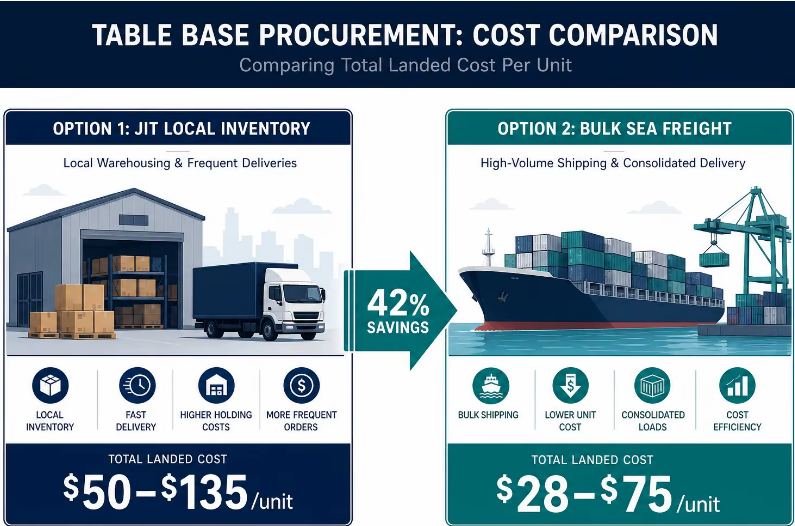
Pricing Comparison: JIT Inventory vs. Bulk Sea Freight
Different procurement models come with completely different cost structures. Here's a cost analysis of the two mainstream
approaches:
| Item | JIT Inventory (Local
Procurement | Bulk Sea Freight (Direct Overseas Sourcing) |
| Unit Price | 45–120/piece | 18–55/piece |
| Shipping Cost | 5–15/piece (ground) | 3–8/piece (sea freight allocation) |
| Customs Duties | None | 5%-25% of cargo value (varies by material and
category) |
Warehousing Cost | Low (on-demand procurement) | Medium (safety stock required) |
Capital Commitment | Low | Higher (30%-50% deposit required upfront) |
All-in Unit Cost | 50–135 | 28–75 |
Optimal Order Quantity | <100 units | >300 units |
Real-world case: A restaurant chain ordered 500 cast iron table bases, choosing a Chinese manufacturer via full container sea freight. The all-in cost was approximately 42% lower than local JIT procurement — but required a 10-week procurement lead time.
Quality Requirements
Restaurant Table Base Supplier Requirements
Restaurant environments impose specific demands on table bases:
Load capacity: Must support tabletops weighing ≥300 lbs plus customer leaning pressure
Stability: Must include adjustable leveling feet to accommodate uneven flooring
Corrosion resistance: Frequent exposure to cleaning agents and water spills — surface finish must pass salt spray testing
Legroom clearance: Ensure sufficient legroom for diners (recommended: base diameter should not exceed 50% of tabletop diameter)
Hotel Table Base Supplier Requirements
Hotel procurement requires special attention to:
Quiet design: Floor glides must provide anti-slip and noise-reduction functionality
Aesthetics: Surface finish must coordinate with the hotel's overall interior design (common options: brushed stainless steel, powder coating, antique bronze)
Modularity: Easy to reconfigure and move when rearranging guest rooms
Fire rating: Public area installations must meet standard fire safety requirements
Accessories Supply
A complete table base procurement involves more than just the main unit. Below is a list of accessories that are often overlooked but critically important:
| Accessory Type | Description | Key Considerations |
| Leveling Glides | Adjust height to
accommodate uneven floors | Confirm thread specification and adjustment range
(typically 17mm) |
| Mounting
Screws/Bolts | Connect the base to the
tabletop | Confirm material (stainless steel recommended); length
must match tabletop thickness |
| Mounting Plate | Adapter piece between base
and tabletop | Confirm hole spacing and dimensions |
Protective
Pads/Floor Glides | Protect flooring and reduce
noise | Nylon or rubber recommended for restaurant use |
Pro tip: Many buyers focus solely on the base unit price while overlooking the hidden costs of accessories. We recommend
clearly listing all accessory requirements when requesting a quote to avoid unexpected additional expenses later.
How to Accurately Communicate Your Needs to Suppliers
Clear communication is the first step to efficient procurement. Here's a checklist of essential information to include when sending an RFQ:
Basic Information
Customer profile: Are you a wholesaler or working on hotel projects?
Product Specifications
Material (e.g., cast iron, stainless steel, aluminum alloy, iron, stamped iron)
Dimensions (base diameter, height, tube diameter/wall thickness)
Surface finish (e.g., matte black powder coating, brushed stainless steel)
Quantity & Lead Time
Initial order quantity
Estimated annual purchase volume
Target delivery date
Willingness to accept partial shipments
Packaging Requirements
Individual packaging or bulk packaging
Custom labels/color boxes needed?
Pallet/wooden crate required?
Supplier Evaluation Checklist + CTA
Before making your final decision, go through this checklist item by item:
| 1 | Have you received physical samples that passed quality inspection? | Status |
| 2 | Have sample test results met your requirements? | ☐ |
3 | Is the surface finish even and free of defects? | ☐ |
| 4 | Have you compared quotes from at least 3 suppliers? | ☐ |
5 | Is the all-in cost (including shipping and duties) within budget? | ☐ |
6 | Can the delivery timeline meet your project schedule? | ☐ |
7 | Are payment terms reasonable (recommended: T/T 30% deposit + 70% before shipment)? | ☐ |
8 | Have you verified the supplier's past customer reviews? | ☐ |
9 | Does the packaging plan provide adequate protection during transit? | ☐ |
Red Flags When Vetting Table Base Suppliers
Watch out for these warning signs:
Quote is more than 30% below the market average
Slow communication or irrelevant responses
Refusal to provide samples or demands unreasonably high sample fees
Cannot provide past customer cases or references
Requires full upfront payment
Conclusion
Choosing the right table base supplier is a systematic process that requires comprehensive evaluation across quality, pricing,
lead time, and service dimensions. Whether you choose the convenience of a US domestic supplier or the cost-effectiveness of
a Chinese manufacturer, the key lies in clear requirement definition and rigorous supplier assessment.
If you're currently looking for a reliable table base supplier, start by clearly defining your own needs, then use the checklist in
this article to filter and evaluate step by step. Remember: the cheapest isn't always the best deal, and the most expensive
isn't necessarily the best. Finding a partner that matches your business scale and quality requirements is what truly matters.
Contact us today for a quote!
📞 WhatsApp: +86 17841353079
📧 Email: aeonti@aeonti.com
🌐 Website: www.aeonti.com